OpenAI Says GPT-6 Models Can Design Protein Shapes and Sequences With Reasoning and Code; an Early Lab Test Found Binding
A partner lab found binding in 35 of 322 minibinders based on GPT-6.2 designs. OpenAI says specialized models still supplied sequences and filtered candidates, so the results do not yet show end-to-end design.
Published
Last updated / Fact-checked on
By DailyMech Staff · November 24, 2026
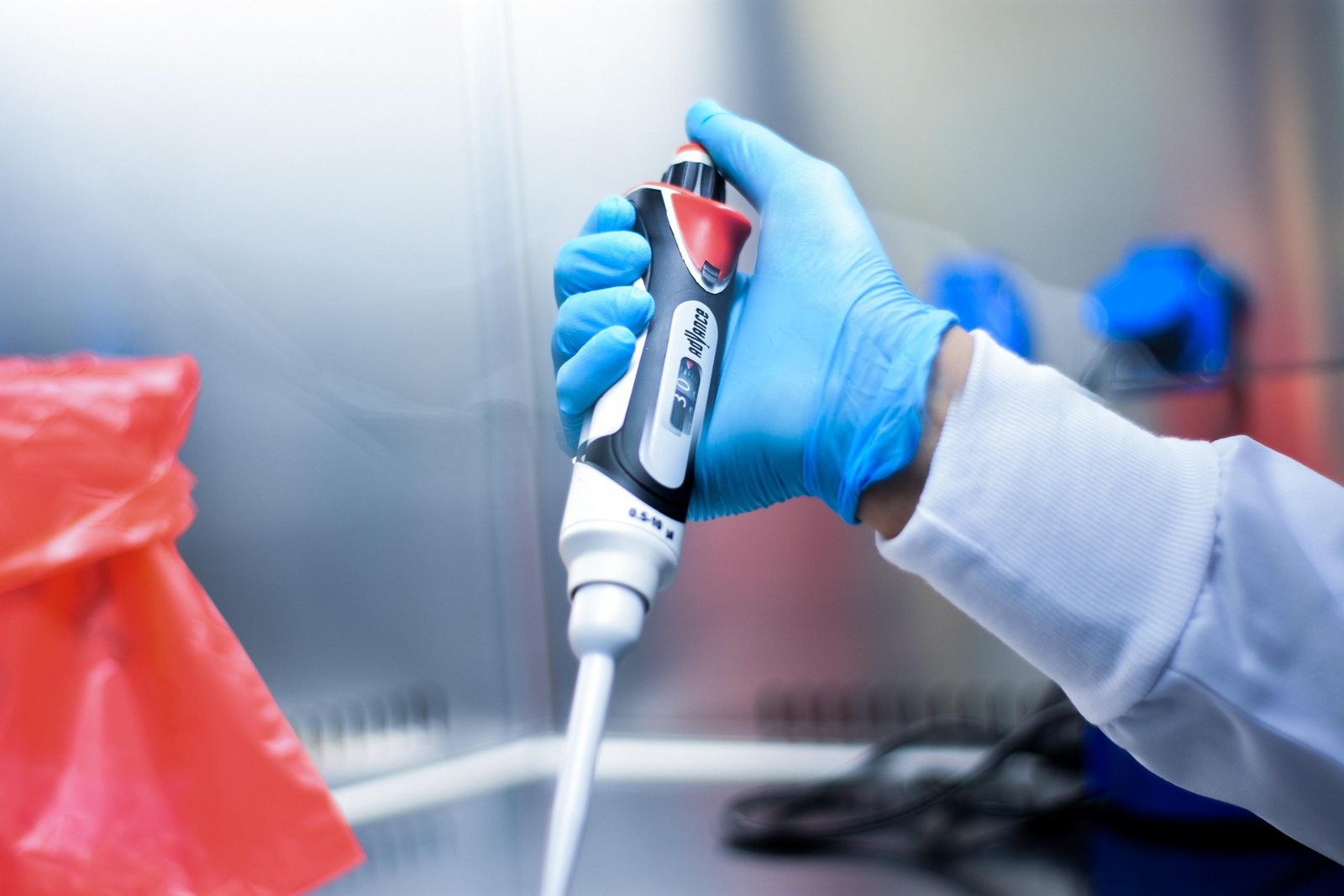
Illustrative photo of a gloved hand holding a micropipette in a lab. It does not show Onava or OpenAI.
OpenAI says its GPT-6 models can design new protein shapes and the sequences of their chemical building blocks using only reasoning and code, without calling specialized biology models to generate those designs. In a lab test with its research partner Onava, a pre-release version of GPT-6.2 produced 3D designs for minibinders against five targets. Of 322 proteins made and tested, 35 (10.9%) showed binding to their intended target. OpenAI says specialized models still supplied sequences and helped filter candidates, and that its results do not yet establish end-to-end design without that help.
At a glance
| Item | Detail | Source/status |
|---|---|---|
| Core claim | GPT-6 family can design protein shapes and sequences using only reasoning and code | OpenAI post, Nov 24, 2026 (fully read) |
| Lab test | 35 of 322 minibinders (10.9%) bound five targets: PD-L1, IL-7Rα, TrkA, VEGF-A, IL-17A | OpenAI post (fully read) |
| Specialized help | SolubleMPNN suggested sequences; Boltz-2, OpenDDE, ESMFold2 and others filtered candidates | OpenAI post (fully read) |
| OpenAI's limit | Results do not yet show end-to-end minibinder design without specialized models | OpenAI post (fully read) |
| Outside view | Nature: about 11% bound; OpenAI's Joy Jiao calls it a proof of principle | Nature, Nov 24, 2026 (fully read) |
| Binding | One step only; function untested | OpenAI post (fully read) |
| Preprint | Named on OpenAI's post | PDF NOT read |
What the lab test showed
OpenAI gave GPT-6.2 the 3D structures of five target proteins and marked where a minibinder should attach. It wrote code to create 3D designs without using specialized protein AI models. SolubleMPNN, a specialized model, then suggested amino acid sequences, and other specialized models helped select candidates for Onava to make and test.
Of the 322 minibinders tested, OpenAI reports 5 hits for PD-L1, 3 for IL-7Rα, 1 for TrkA, 8 for VEGF-A and 18 for IL-17A, at least one for each target. OpenAI notes that the original RFdiffusion study reported higher hit rates, but says rates depend heavily on how strictly designs are filtered and how binding is defined. In computational checks, GPT-6.2's designs scored slightly lower than RFdiffusion's, while OpenAI's latest internal models scored higher. Those internal-model results were not lab-tested.
In other experiments, where specialized models again helped choose what to test, GPT-6.2 proposed new sequences for known minibinder structures. In initial screens, 75 of 88 designs bound MDM2, 26 of 42 bound VEGF-A and 8 of 59 bound PD-1. For three unpublished shapes, 14 of 107 proteins (13.1%) bound. OpenAI also reports binding in 128 of 182 antibody loop designs for IL-4Rα.
What specialized models still did
OpenAI's Limitations section says the campaign "relied on specialized structure prediction models such as Boltz-2, OpenDDE, and ESMFold2 to filter candidates." It says GPT models show capability comparable to specialists at backbone generation and sequence redesign, but that the results "do not yet establish" end-to-end generation without specialized help.
Predicting a full protein structure from a sequence remained a clear weakness. Average scores were 0.16 for GPT-5.6, 0.26 for GPT-6.2 and 0.38 for the latest internal model, against 0.93 for the specialized ESMFold2. OpenAI also cautions that unusually high accuracy on inferring sequences from structures may partly reflect memorization or patterns left by how the structures were generated.
What outside scientists say
Nature reported that lab experiments showed around 11% of designs bound their target. OpenAI's Joy Jiao, who leads life-sciences research, emphasized that the work is a proof of principle and that specialized tools were still needed for key steps. Martin Pačesa, a structural biologist at the University of Zurich, told Nature that "in most cases, a specialist will always perform better than a generalist for a given task." Nature added that some researchers question how much the models learn about protein biology and suggest some abilities could reflect regurgitated training data. OpenAI researcher Masatoshi Uehara said he believes a language model "can technically beat every specialized model."
Binding is not a medicine
OpenAI says binding "is only one step toward a useful research tool or medicine," and that specificity, stability, biological activity, safety and efficacy would still need to be established. Its next goals include harder targets and designs tested for effects after binding, such as killing a cancer cell.
OpenAI also says the same capabilities that help design medicines "could also be misused," and that its Preparedness Framework guides how it assesses those risks and tests safeguards. The post gives no risk rating or safeguard details.
What to watch
Whether OpenAI's harder-target and function tests succeed, and whether outside labs reproduce the results. DailyMech found no independent replication so far.
How we reported this
DailyMech read OpenAI's Nov. 24 post and Nature's Nov. 24 news story in full. It could not read OpenAI's preprint PDF, which returned a server error, and cites it only as named on the post. All results are OpenAI's own. DailyMech contacted no one and found no statement from Onava.
Sources
- OpenAI, "GPT-6 models demonstrate intrinsic protein-design capabilities," Nov 24, 2026, https://openai.com/index/gpt-6-models-demonstrate-intrinsic-protein-design-capabilities (fully read).
- OpenAI preprint, "GPT-6 as a Universal Foundation Model for Protein Biology: Beyond Specialized Models," https://cdn.openai.com/pdf/gpt-6-a-universal-foundation-model-for-protein-biology.pdf (NOT read; fetch failed; cited via OpenAI's post).
- Ewen Callaway, "Watch out, AlphaFold: Claude and ChatGPT's new biology skills wow scientists," Nature, 24 Nov 2026, https://www.nature.com/articles/d41586-026-03836-z (fully read).
AI note
This article was drafted with AI assistance by Grok (Auto mode) from a human-prepared source brief, then audited line by line against OpenAI's post and Nature's story. It was reviewed by DailyMech's editor and approved by Miguel Maldonado before publication.