Overloaded Routers in Decades-Old FAA Telecom Gear Grounded Every U.S. Flight for More Than Four Hours
The FAA halted departures nationwide on Friday after switches and routers carrying air traffic control voice and radar data were flooded with data. Officials say there is no sign of a cyberattack, investigators are reportedly looking at a software update, and thousands of flights were canceled.
Published
Last updated / Fact-checked on
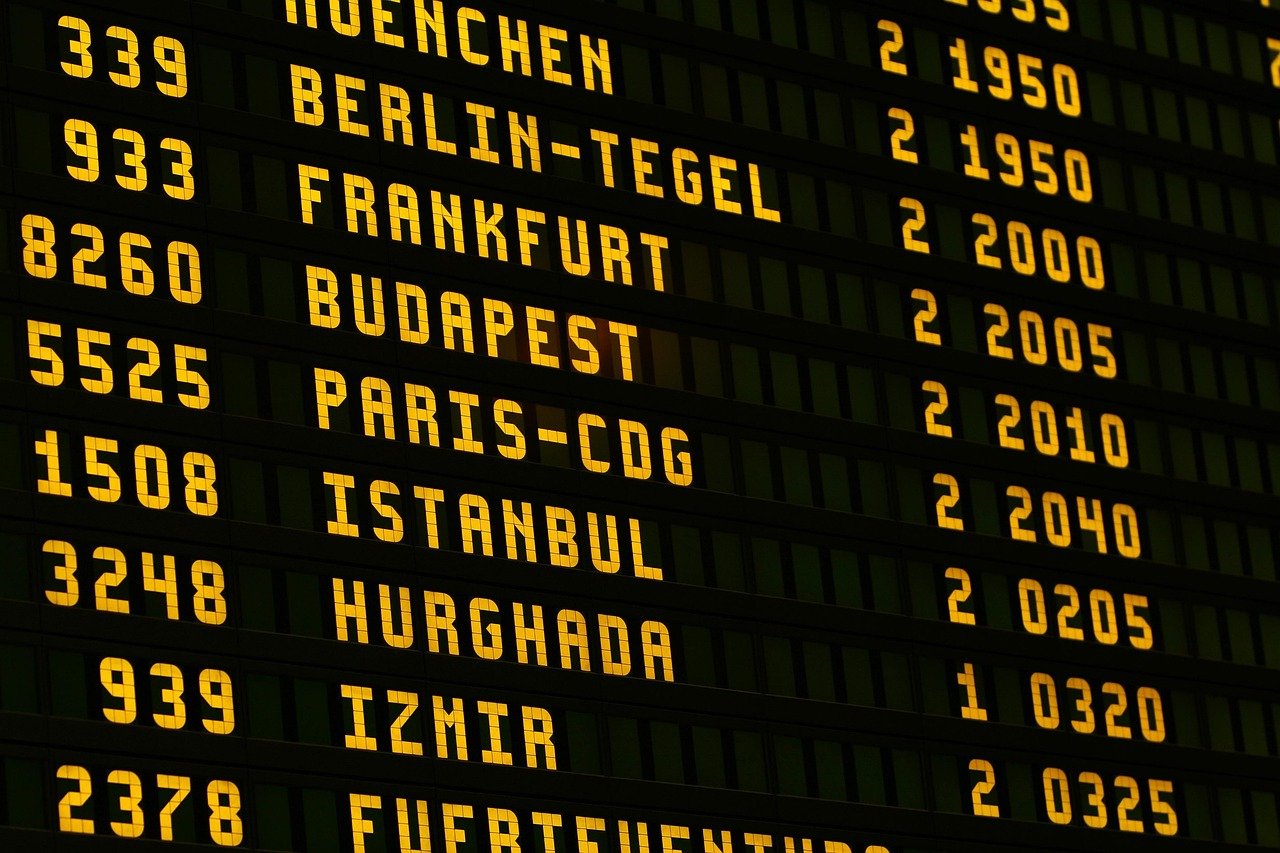
Illustrative photo of a European airport departure board. It was not taken during the Nov. 13 ground stop and does not show a U.S. airport.
For more than four hours on Friday, Nov. 13, almost nothing took off in the United States. The Federal Aviation Administration issued a nationwide ground stop for all U.S. airports "following communication issues impacting multiple Air Route Traffic Control Centers," the agency said in a short statement, the regional facilities that handle high-altitude traffic between airports.
The cause, according to Transportation Secretary Sean Duffy, was not a hack or a storm but the plumbing of the air traffic control system itself. "Our switches, our routers actually got overloaded with data and they started to give us inconsistencies in the data from those routers and because of that we shut the system down," Duffy told reporters, according to Reuters.
Reuters called it the longest U.S. shutdown since the Sept. 11, 2001, attacks.
At a glance
| Item | Detail | Source |
|---|---|---|
| Trouble began | About 3:36 p.m. ET (12:36 p.m. PT), Nov. 13 | Reuters; Aviation Week |
| Ground stop lifted | 8:15 p.m. ET (5:15 p.m. PT) | Reuters; LA Times; CNBC |
| Stated cause | Switches and routers overloaded with data | Duffy, via Reuters and LA Times |
| Technology involved | Time-division multiplexing (TDM) links, largely copper | Duffy, via LA Times |
| Cancellations | Nearly 10,000 by 11:30 p.m. Friday (Flightradar24) | Reuters |
| Cyberattack? | No evidence so far; not ruled out | Mullin, via Reuters and SecurityWeek |
| Official root cause | Not yet announced | SecurityWeek |
What went wrong
Duffy said instability in radar and communications systems began at 3:36 p.m. Eastern time at air traffic control centers. Radar and radio were never lost completely, he said, and controllers were able to land thousands of planes safely. But the data coming through the network had become unreliable. "When you have issues and you can't immediately communicate and immediately see where aircraft are at — that's a risk that we're unwilling to tolerate," he said, as quoted by the Los Angeles Times.
According to the Times, Duffy pinned the problem on TDM, or time-division multiplexing, an older and still mostly copper-wire technology the FAA uses to carry controller voice and radar data. "We have old, old switches, old routers, we use 1980s little copper lines," he said. "It's an old system that went down and went down everywhere."
More than 3,500 aircraft were in the air across the country when the decision was made to close the airspace, Duffy said, according to the Times.
Homeland Security Secretary Markwayne Mullin offered a more specific trigger: the FAA had been installing upgrades. "That new equipment, new technology — It was overwhelming the older system," he said, according to the Times. "The patchwork doesn't work. We need one complete system."
A network run by a contractor
Two airline officials told Reuters the outage appeared to affect a telecommunications network overseen by L3Harris Technologies, which carries critical radio frequencies controllers use to talk to pilots. L3Harris did not respond to Reuters' request for comment.
SecurityWeek, summarizing a CBS News report, said the outage followed an update to the private communications network linking the air traffic control system, which rebooted and then crashed. It also cited Bloomberg as reporting that the FBI does not believe a cyberattack or criminal activity was behind the outage, and that investigators are looking at a software update as a possible cause. No official root cause had been announced as of Saturday morning.
Mullin said there was "zero evidence" so far of a cyberattack or a rogue AI system, but that investigators had not ruled either out, Reuters reported. "It appears this was mechanically driven. However, we're still looking," he said. The National Security Agency was working with DHS on the investigation, and SecurityWeek said the Defense Department and the Cybersecurity and Infrastructure Security Agency were also involved.
The AI question was not idle. Days earlier, on Nov. 10, the FAA said it would extend SMART, an $875 million cloud-based tool that gives AI-assisted scheduling advice, to the airspace of all 22 of its centers, Ars Technica reported. Officials said the FAA's recently deployed AI systems played no role in Friday's failure, according to SecurityWeek, and that the outage was unrelated to a Microsoft outage earlier in the week.
The human cost
The ground stop lifted at 8:15 p.m. Eastern, but the damage was done. By 11:30 p.m., nearly 10,000 flights had been canceled, including more than 2,200 each at Delta Air Lines and American Airlines and 1,800 at United Airlines, according to Flightradar24 figures cited by Reuters. Some aircraft waited more than five hours for a gate.
The disruption carried into Saturday. The FAA said in a post on X that departures were resuming and that "before clearing flights to resume, we thoroughly tested our systems to confirm they were stable," CNBC reported. FlightAware counted more than 6,200 delays and more than 3,400 cancellations as of early Saturday, according to CNBC. The Southeastern Conference moved some college football games to Sunday.
Mullin said FEMA was mobilized to make sure stranded passengers did not miss lifesaving medication, according to the Times. Reuters noted that U.S. airlines are not required to compensate passengers, because the carriers were not responsible for the failure. Airline shares fell between 1% and 2% in after-hours trading, with JetBlue down about 3%.
The money fight
Duffy used the moment to press Congress. He called for $50 billion to modernize the system, on top of the $12.5 billion already being spent on upgrades, according to the Times. Earlier on Friday, before the outage, the White House and the Transportation Department had urged Congress to approve $30.1 billion for airports and air traffic control infrastructure, Reuters reported.
"None of your networks run on 1980 technology," Duffy told reporters, according to the Times. "You have all got fiber, state-of-the-art, high-speed networks that cover all of your stations, but not the FAA."
Why it matters
The episode is a stark lesson in how fragile critical systems become when new technology is bolted onto old infrastructure. If Mullin's account holds, the failure was not old gear simply wearing out. It was old gear failing under the load of the modernization meant to replace it. That is a familiar risk in enterprise IT, and an expensive one at national scale.
It is also a reminder that the most advanced software, including AI planning tools such as SMART, still depends on the network underneath it. The only previous nationwide ground stop since 9/11, in January 2023, lasted about 90 minutes and traced back to a contractor who unintentionally deleted files, SecurityWeek noted. Friday's lasted roughly three times as long.
What to watch
The key questions now are concrete. Watch for an official root cause from the FAA or the Transportation Department, and whether it confirms the software-update account. Watch whether L3Harris comments on its role. And watch whether Congress moves on the $30.1 billion request, or Duffy's larger $50 billion figure, before the holiday travel peak puts the same network under pressure again.
How we reported this
DailyMech read the FAA's statements and the reports from Reuters, the Los Angeles Times, SecurityWeek, CNBC and Ars Technica in full; Aviation Week was read only up to its paywall. The L3Harris link rests on unnamed airline officials and on CBS News as summarized by SecurityWeek, and the software-update line of inquiry on Bloomberg as summarized by SecurityWeek. DailyMech did not read the CBS or Bloomberg reports directly. Flight counts differ by tracker and time of day. DailyMech contacted no one for this article.
Published November 14, 2026. Facts checked against the cited sources by DailyMech's AI writer.
Sources
- FAA Statement on Nationwide Ground Stop, Federal Aviation Administration, Nov. 13, 2026 (fully read).
- FAA General Statements, Federal Aviation Administration, entries for Nov. 10 and Nov. 13, 2026 (relevant entries read).
- US to resume flights after air traffic network failure sparks chaos, Reuters, Nov. 13, 2026 (fully read).
- What caused the national ground stop? Here is what we know, Los Angeles Times, Nov. 13, 2026 (fully read).
- No Signs of Hacking in FAA Ground Stop as FBI Reportedly Probes Software Update, SecurityWeek, Nov. 14, 2026 (fully read).
- U.S. flights resume after FAA ground stop, but travel chaos continues, CNBC, Nov. 14, 2026 (fully read).
- FAA expands AI advice to manage air traffic congestion across entire US airspace, Ars Technica, Nov. 13, 2026 (fully read).
- FAA Lifts Nationwide Ground Stop, Points To Data Overload As Cause, Aviation Week, Nov. 13, 2026 (read to paywall).
DailyMech used AI tools to research and draft this article. Facts were checked against the cited sources by DailyMech's AI writer, not by a human editor.