AGIBOT Proposes 'Worken' to Measure How Much Useful Work Robots Actually Do
At its Shanghai Innovation Day, AGIBOT paired the new productivity metric with the AHA3 hardware platform, the GO-3 Preview model and the G2 Max industrial robot.
Published
Last updated / Fact-checked on
Chinese robotics company AGIBOT introduced "Worken" at its Innovation Day 2026 in Shanghai on October 29. It is a proposed metric that multiplies active robots by autonomous working hours and by an output-efficiency ratio. It measures useful work, not units built. AGIBOT also unveiled new hardware, AI models, an industrial robot and an operating system.
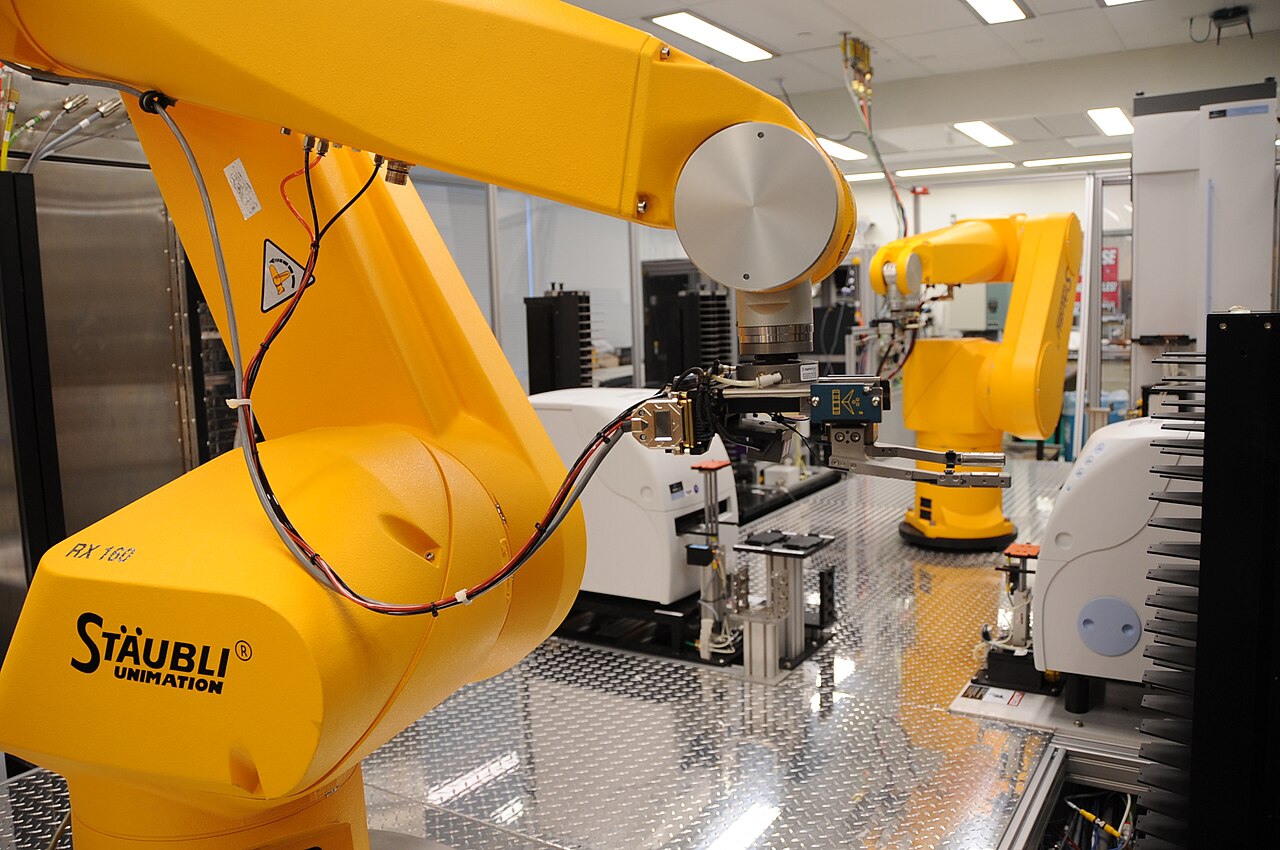
Illustrative photo of robot arms in a lab, not AGIBOT hardware. Image: Maggie Bartlett, National Human Genome Research Institute / Public domain, via Wikimedia Commons
How Worken is calculated
The name combines "work" and "token." AGIBOT also describes it as "Effective Intelligent Work Hours":
Worken = Number of Active Robots × Autonomous Working Hours × Output Efficiency Ratio
| Factor | What it counts |
|---|---|
| Active robots | Robots doing tasks in real environments, not units in inventory |
| Autonomous working hours | Time spent working on their own, not total powered-on time |
| Output efficiency ratio | Output against a task benchmark, such as acceptable work by a human under set standards |
"Worken is our attempt to develop a new way of answering that question," said Peng Zhihui, AGIBOT's co-founder, president and CTO. The question he was referring to is how much productive work robots actually deliver. AGIBOT calls Worken an evolving framework that it will refine with deployment data and task-specific benchmarks.
Worken also appears in the "2026 Embodied Intelligence Industry Innovation Report," released at the event by China Economic Information Service and a CAICT center in Shanghai.
AHA3 hardware and AGILE motion
AHA3 is AGIBOT's third-generation humanoid hardware architecture. The company calls it its first commercial "Three Intelligences in One" platform, combining locomotion, interaction and task execution. AGIBOT says it includes:
- Wi-Fi 6 and 5G connectivity
- a joint liquid-cooling system for continuous operation
- IP67-rated joints
- a new hand lineup: OmniHand 3 Lite, OmniHand 3 and OmniHand 3 Ultra, plus the OmniPicker 3 tactile gripper
AGIBOT also added a self-evolving agent capability to AGILE, its end-to-end motion intelligence framework. The capability is meant to let robots improve through experience at real sites.
GO-3 Preview and WITA-Omni
GO-3 Preview is AGIBOT's next-generation embodied foundation model. It is built on a framework the company calls WRAM (World Reasoning Action Model), which is designed to help robots anticipate the consequences of their actions. AGIBOT demonstrated zero-shot and few-shot tasks. It also says the model ranked first in task success rate and process score on RoboDojo, scored highest overall on RoboTwin, and ranked first overall on RoboColiseum. These results are company-reported and have not been independently verified.
WITA-Omni is an interaction model that combines vision, speech, real-time dialogue, facial expressions and physical actions. It supports full-duplex conversation and on-device deployment.
G2 Max and real deployments
The G2 Max is a heavy-duty robot for manufacturing and logistics. It has:
- 21 degrees of freedom
- dual-arm handling of up to 40 kg
- an adjustable working height of 0.1 to 2.5 meters
- force-controlled manipulation and omnidirectional mobility
AGIBOT cited deployments of its G2 family, including:
- production-line material handling for tablet production at Longcheer
- semiconductor packaging and testing
- CNC machine tending
- logistics
Its service robots work at Guangzhou Metro and the Chimelong tourism complex.
Link-U OS goes open source
AGIBOT released Link-U OS 1.0, which it calls an operating system for embodied intelligence. Selected partners are trialling it, and AGIBOT plans to make it fully open source by the end of 2026. The company is donating the project to the OpenAtom Foundation, where it became a Platinum sponsor. AGIBOT says its ecosystem spans 255 universities, 511 enterprises and more than 80,000 developers.
Why it matters
Robot makers usually report progress as units shipped or production milestones. Worken tries to measure what deployed robots actually accomplish, which is the number buyers care about.
For now it is one company's proposal. Its usefulness depends on how "active," "autonomous" and the reference benchmarks are defined. Unless those definitions are shared and audited, Worken figures from different vendors won't be comparable. Buyers can still use its three factors as a checklist: utilization, intervention-free hours and output against a human baseline.
More robotics coverage is in our Artificial Intelligence hub.
How we reported this
This article is based on AGIBOT's October 29 press release. Product specifications and benchmark results are the company's own. We cut a production-milestone claim from the draft that the source did not support.
Sources
- AGIBOT: AGIBOT Introduces Worken to Measure Productive Robot Work at AGIBOT Innovation Day 2026, Oct 29, 2026.
DailyMech used AI tools to help research and draft this article; it was fact-checked by our editors.