Anthropic Says Claude Found a CRISPR-Like Enzyme System. Here's What Is and Isn't Proven
Claude agents flagged an uncharacterized phage reverse transcriptase system called ART. Its function is still unknown, and outside scientists are cautious.
Published
Last updated / Fact-checked on
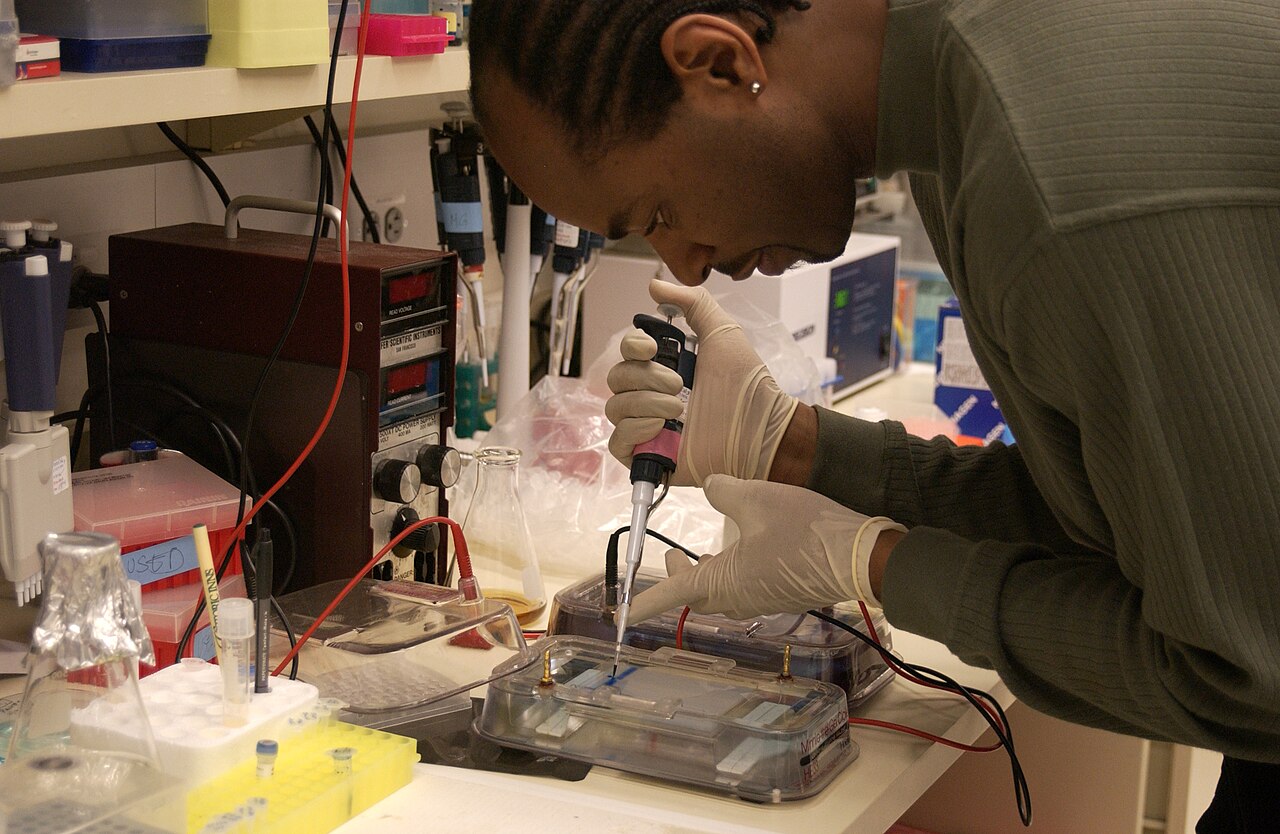
Anthropic says roughly 950 Claude agents, working for 21 hours, found a previously uncharacterized enzyme system in bacteriophages. It sits next to an array of DNA repeats that resembles CRISPR. The company announced the work on September 23, 2026. Nobody yet knows what the system, called ART, does. It has not been shown to edit genes, and the technical report has not been peer-reviewed.
Image: Maggie Bartlett, NHGRI / Public domain, via Wikimedia Commons
What Anthropic announced
ART stands for array-associated reverse transcriptases. Reverse transcriptases (RTs) are enzymes that copy RNA into DNA. According to Anthropic, ART is found mainly in bacteriophages, the viruses that infect bacteria. It has three parts:
- a reverse transcriptase
- a partner gene of unknown function beside it
- a long array of evenly spaced DNA repeats
The RT itself was already known. Anthropic says it had been identified in earlier studies of a jumbo phage. The company's claim is that Claude was the first to notice the repeat array and the accessory protein around it. Anthropic says its first lab experiments show the array is expressed as a set of distinct short RNAs. That is suggestive, because CRISPR arrays hold banks of RNA sequences that make CRISPR-Cas systems programmable. It is not proof of a similar mechanism.
How the agents searched
Anthropic says its scientists wrote the initial prompt and ran the lab work. Claude agents did the database search and chose which candidates to pursue.
| Stage | Reported figure |
|---|---|
| Agents running | About 950 |
| Search time | 21 hours |
| Tokens used | 210 million |
| RTs gathered | More than 200,000 |
| New candidate systems | 3,500 |
| Candidates written up for humans | 20 |
Anthropic says this kind of analysis can take an expert weeks to months. Before filing its report, the agent counted the repeats, measured their spacing, compared the layout with known RT systems and searched the literature.
The lab behind it
The finding is the first result from a life sciences research group that Anthropic formed in spring 2026. The group has a molecular biology lab in the Bay Area. Anthropic says the lab works only at biosafety levels 1 and 2, handles no pathogens that infect humans, and has human scientists do all the bench work.
After reviewing the preprint, CRISPR pioneer Feng Zhang of MIT and the Broad Institute called the RNA-repeat arrays "genuinely intriguing" and said they merit further investigation, according to Anthropic.
What outside scientists say
Reaction has been measured. In WIRED's coverage, Stanford's Le Cong said: "The experiments are still in the queue. The PR is already live." Gladstone Institutes researcher Seth Shipman told WIRED he does not think ART is a new CRISPR system, and that "the novel thing is how they found it, not what it is." WIRED also reported:
- the RT had been described in a 2021 jumbo-phage paper by Texas A&M microbiologist Jason Gill and colleagues
- the agent itself noted that ART could be a retron, a different bacterial immune system
Nature later added a note citing a New York Times report. In it, University of Copenhagen scientist Mario Rodríguez Mestre said his group had studied the system for years and had uploaded information about it to Anthropic's models. According to that report, Anthropic said the model was "not trained on any user transcripts."
What to watch
- Function: whether experiments show what ART does in phages
- Mechanism: whether the short RNAs guide the enzyme the way CRISPR RNAs guide Cas proteins
- Peer review: whether the technical report holds up under peer review and independent replication
- Provenance: how questions about credit for the prior work get resolved
For now, ART is an interesting genomics lead and a test case for agent-driven hypothesis generation. It is not a gene-editing tool. More AI-in-science coverage is in our Artificial Intelligence hub.
How we reported this
We checked the figures and quotes against Anthropic's announcement. We confirmed outside reaction through WIRED and Nature coverage found via search. The draft cited Smithsonian Magazine, but we could not open that article, so we cut the details that relied on it. We also removed tracking parameters from the links.
Sources
- Anthropic: Claude discovers a novel enzyme system with CRISPR-like repeats, Sep 23, 2026.
- WIRED: Anthropic Says It Discovered a Crispr-Like System. Now What?
- Nature: Anthropic's AI biolab finds 'CRISPR-like' DNA in viruses. What's next?
DailyMech used AI tools to help research and draft this article; it was fact-checked by our editors.