Google and XREAL Launch AURA, the First Wired Android XR Glasses, From $1,099
The see-through glasses put Android apps, virtual screens and Gemini in your field of view, with processing handled by a wired compute puck.
Published
Last updated / Fact-checked on
Google and XREAL launched XREAL AURA on Oct. 28, 2026, calling it the first wired XR glasses powered by Android XR. The base model has a $1,279 list price, but it sells for $1,099 through December 2026 as a limited-time launch offer. Orders are open now, and shipping is expected to start in mid-November.
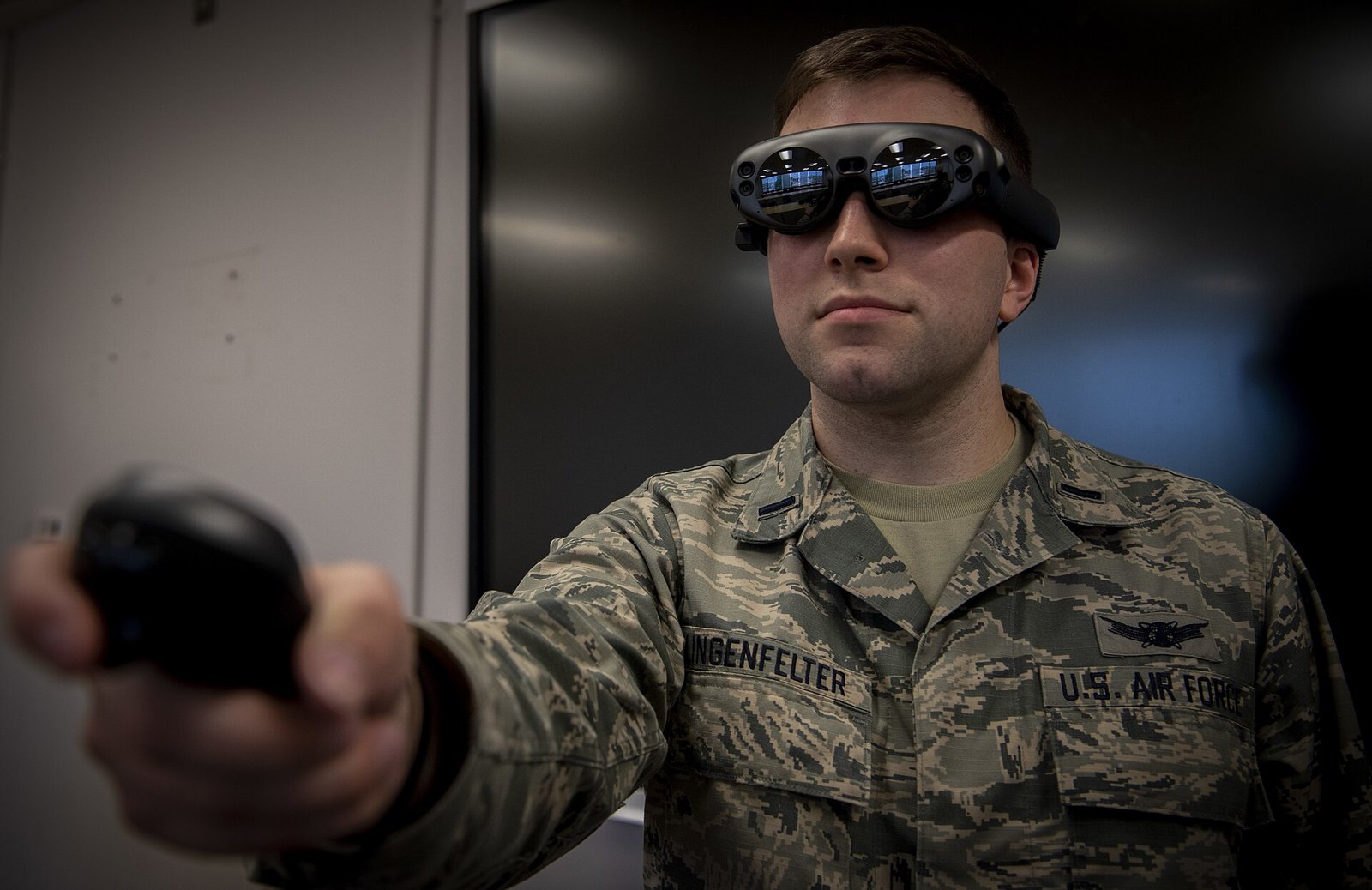
Illustrative image, not the AURA device. U.S. Air Force photo by Airman 1st Class Jonathan Whitely, public domain, via Wikimedia Commons.
Price, configurations and availability
XREAL's release lists two configurations, and both have launch discounts that run through December 2026:
| Configuration | List price | Launch offer |
|---|---|---|
| 12GB + 256GB | $1,279 | $1,099 |
| 16GB + 512GB | $1,499 | $1,299 |
XREAL says the offer applies to standalone purchases in all launch markets and does not apply to bundles. Google describes the same pricing as starting at USD 1,099 "through the end of the year."
Orders are open in the U.S., Canada and South Korea through xreal.com/aura, and in the U.S. through BestBuy.com as well. Google says orders in Japan open Nov. 2. XREAL's release lists Japan as a launch market without giving a separate date. Buyers must be 18 or older.
Lightweight glasses, separate compute puck
AURA uses transparent, optical see-through lenses, so you see the room directly while apps appear in a 70-degree field of view. The glasses weigh under 95 grams. That's possible because the heavy processing happens in a pocketable puck connected by a cable.
The puck holds the battery and Qualcomm's new Snapdragon Reality Elite platform, which debuts on AURA. It can also work as a trackpad. XREAL lists these other specs:
- Sony Micro-OLED displays at 1200p and 120Hz
- Sound by Bose
- XREAL's X1S chip
- Electrochromic dimming
- Input by voice, hand tracking, keyboard, trackpad and game controller
The trade-off is clear. Moving the compute off your head makes the glasses lighter, but AURA is not a self-contained wearable. You are always tethered to the puck.
What Android XR and Gemini add
Android XR gives AURA access to millions of Google Play apps, and Google says more than 150 of them are built for XR. You can arrange several app windows around you and pair a Bluetooth keyboard and mouse.
A feature called Wired Mirroring brings in a laptop or handheld game console over a USB-C cable that supports video output. The device's screen appears as a resizable window, and you don't need to install any software.
Gemini works across what you see, including mirrored windows and your physical surroundings. According to Google, starting at launch you can share your view and Gemini will highlight what to focus on, either on screen or in the room. For entertainment, AURA supports YouTube and Google TV, including 180- and 360-degree and 3D video. Launch titles include Nevatars, the San Francisco Ballet's Nutcracker, Fallout: Factions and Project Hail Mary: Journey Among the Stars.
How it compares with Meta's display glasses
Meta's Ray-Ban Display glasses launched in the U.S. in September 2025 for $799, a price that includes the Meta Neural Band wrist controller. AURA's $1,099 launch price is $300 higher.
The two products aim at different jobs. Meta's glasses are a self-contained everyday pair with a small built-in display. AURA trades that self-containment for a large spatial workspace and full Android app support, and it needs a wired puck to deliver them.
What to watch before buying
The spec sheet is ambitious, but the claims about comfort, battery life and app quality all come from the companies themselves. Independent reviews of production units will be the real test once shipping starts in mid-November.
If you're weighing a purchase, decide before December ends. That's when the $180 and $200 launch discounts expire. Also check that your laptop's USB-C port supports video output if you plan to use Wired Mirroring. For more on wearables and assistants, see our Artificial Intelligence hub.
How we reported this
We checked the price, specs, markets and dates against Google's launch post and XREAL's press release, both published Oct. 28, 2026. The Meta comparison comes from Meta's own launch announcement. We removed unsourced claims from an earlier draft. We have not tested AURA.
Sources
- Google, "XREAL AURA: Wired XR glasses to watch, work, and play," Oct. 28, 2026: https://blog.google/products-and-platforms/platforms/android/xreal-aura/
- XREAL via PR Newswire, "XREAL AURA Launches as the First Wired XR Glasses Powered by Android XR," Oct. 28, 2026: https://www.prnewswire.com/news-releases/xreal-aura-launches-as-the-first-wired-xr-glasses-powered-by-android-xr-302921776.html
- Meta, "Meta Ray-Ban Display" launch announcement, September 2025: https://www.meta.com/blog/meta-ray-ban-display-ai-glasses-connect-2025/
DailyMech used AI tools to help research and draft this article; it was fact-checked by our editors.