Anthropic Expands AI for Science to 20 Partners, From NSF to the Francis Crick Institute
Free Claude credits will flow through six funders, six research institutions and six named projects, and Imperial plans to test whether Claude can rediscover an unpublished gene-transfer mechanism.
Published
Last updated / Fact-checked on
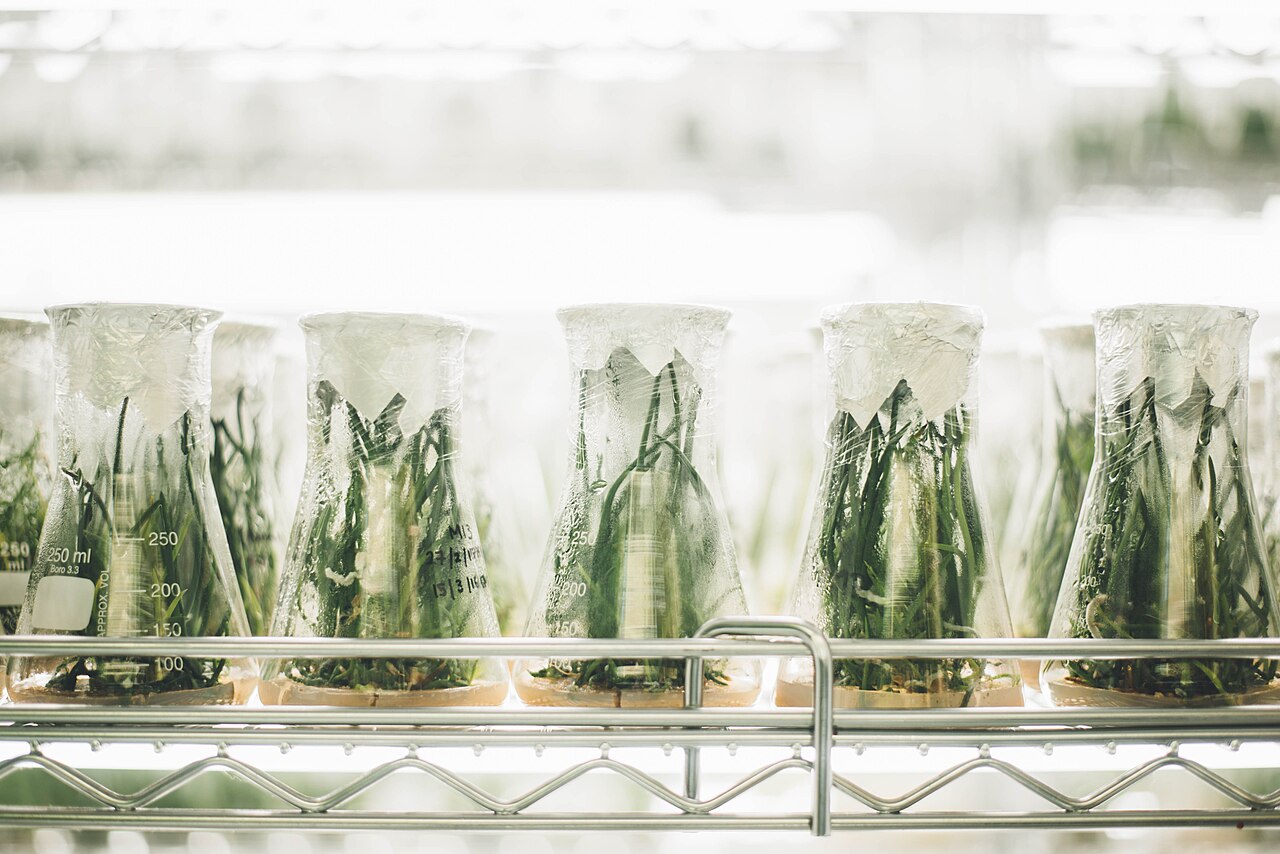
Anthropic said on October 28, 2026, that it is expanding its AI for Science program, which gives researchers free Claude credits, to 20 scientific foundations, institutions and research projects. Partners include the U.S. National Science Foundation, the Francis Crick Institute and the Broad Institute's gnomAD project.
Image: Illustrative photo of plants in lab beakers. chuttersnap (Unsplash) / CC0 1.0, via Wikimedia Commons
How the program works
AI for Science started in May 2025. Anthropic says it has since supported hundreds of projects across biology, medicine, physics, chemistry, climate science and mathematics, and launched a discounted Team plan for scientists. Researchers tell the company they use Claude to generate hypotheses, design experiments, analyze data and communicate results.
The expansion routes credits through partners instead of only through individual applications, so they reach more scientists.
The 20 partners
Funders and societies that will pass credits on to researchers they support:
- Alfred P. Sloan Foundation
- Simons Foundation
- Schmidt Sciences
- Open Source for Science Fund, a program of Renaissance Philanthropy
- U.S. National Science Foundation
- CAS, a division of the American Chemical Society
Institutions using credits internally:
- Space Telescope Science Institute, which runs science operations for Hubble and Webb
- Wellcome Sanger Institute
- Francis Crick Institute
- Imperial College London's Department of Life Sciences
- EMBL, Europe's intergovernmental life sciences lab
- Gladstone Institutes
Projects receiving credits directly:
- FlyWire (Princeton), which mapped the complete wiring of an adult fruit fly brain
- LEAP (Columbia), which uses machine learning to improve climate models
- AstroPath (Johns Hopkins), which applies astronomy imaging methods to tumors
- gnomAD (Broad Institute), an open reference of human genetic variation built from more than 800,000 people
- Tau Ceti, a community project formalizing mathematics in the Lean proof language
- The Centre for Population Genomics in Australia
The list also counts two earlier collaborations. With HHMI's Janelia Research Campus, Anthropic is working on the Model Hardware Standard, a specification that lets AI agents safely operate lab instruments, now in research preview. It also supports the Allen Institute's teams of AI agents analyzing open datasets on the brain, cells and immune system.
A test at Imperial
Imperial College London described what its partnership will involve. Anthropic will provide token access to research groups across Imperial and work most closely with the Department of Life Sciences.
One project targets fungal pathogens. Researchers including Professors Doryen Bubeck, Tolga Bozkurt and Nikolai Windbichler and Dr Jiorgos Kourelis have a method that predicts, with about 90% accuracy, how a key class of immune-suppressing fungal proteins interacts with hosts. They plan to pair it with Claude-assisted protein design to block those attacks, aiming eventually at disease-resistant crops.
The more unusual experiment comes from Dr Tiago da Costa's lab. The team will test whether Claude can independently identify a previously unknown, unpublished gene-transfer mechanism recently discovered in the lab, using only experimental evidence that was public before the discovery.
"The real promise of AI is not simply to make science faster, but to help us think differently," da Costa said.
Why it matters
The da Costa test is a cleaner benchmark than most AI-for-science claims, because the answer is unpublished and cannot have leaked into training data. A similar test was run in 2025, when Google's AI co-scientist matched a bacterial mechanism reported in Cell.
Anthropic says many of the collaborations should produce public goods, such as open datasets, software, standards and shared libraries. It stresses that the projects are at an early stage.
Researchers interested in credits should check whether their funder, institution or project is on the list. If not, note that Anthropic says it intends to expand to more partners.
More coverage of AI in research is in our Artificial Intelligence hub.
How we reported this
We checked the partner list and program details against Anthropic's announcement. The Imperial projects, including the gene-transfer test, come from Imperial College London's news release, not Anthropic's post. We trimmed partner descriptions for length but did not change their substance.
Sources
- Anthropic: AI for Science expands to foundations and institutions, Oct 28, 2026.
- Imperial News: New Anthropic partnership explores how AI could advance biological discoveries, Oct 29, 2026.
- Cell: AI co-scientist and cf-PICI mechanism, 2025.
DailyMech used AI tools to help research and draft this article; it was fact-checked by our editors.