China's Carmakers Pull Humanoid Robots Back From the Assembly Line, Caixin Reports
A three-second window per task on a 60-cars-an-hour line, hands that wear out, and vision systems blinded by welding sparks have pushed Geely, XPeng, Li Auto and others to shrink their humanoid plans toward sorting, showrooms and human-robot teamwork.
Published
Last updated / Fact-checked on
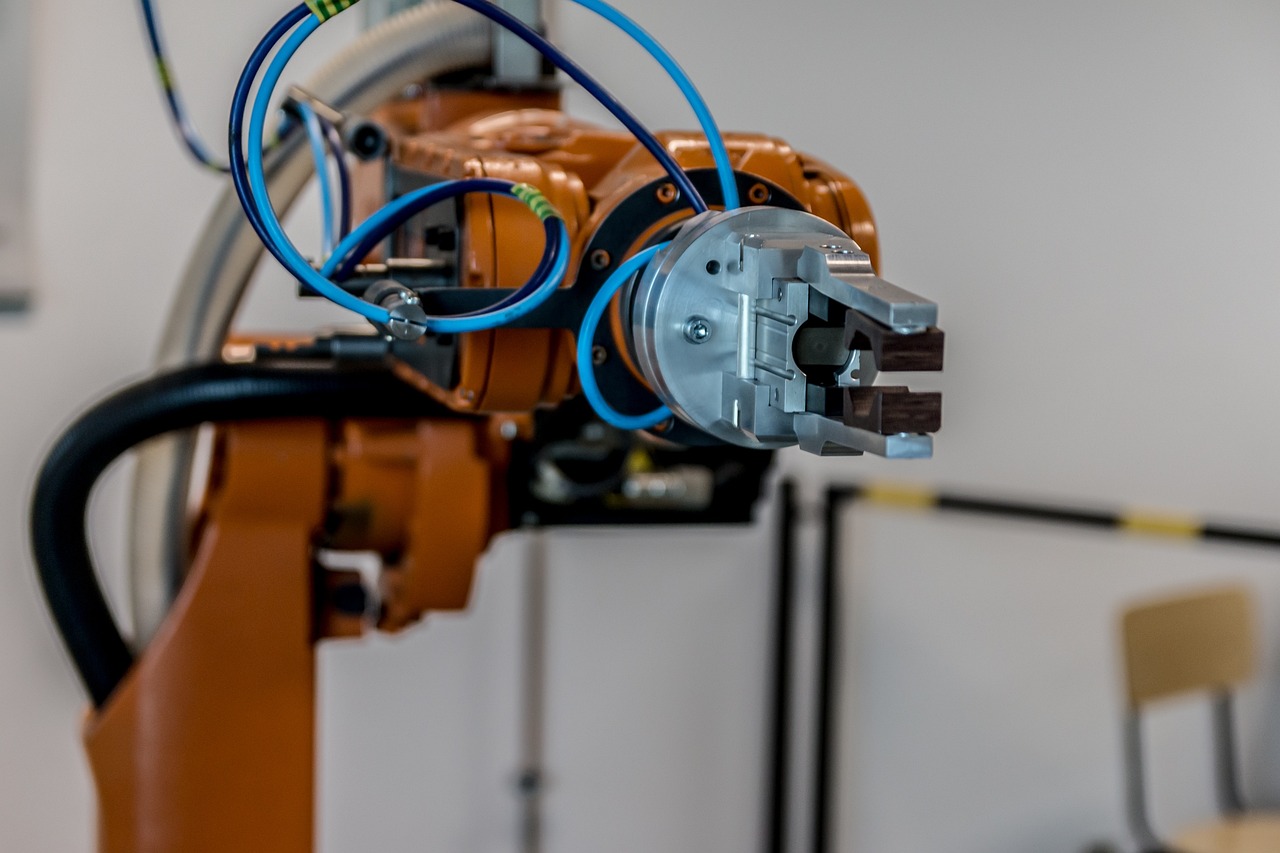
Illustrative photo of a conventional industrial robot arm with a gripper. It is not from any automaker's plant and is not a humanoid.
For a while, car factories were supposed to be where humanoid robots proved themselves. Chinese automakers lined up to announce deployments, and Western partnerships such as BMW's with Figure set the tone. Now, according to an in-depth report published Nov. 13 by Caixin, the carmakers are quietly scaling back. The robots were too slow, too fragile and too expensive for the arithmetic of mass production, and automakers are recasting them as helpers for simpler jobs rather than replacements for assembly workers.
The report, by Caixin reporters An Limin, Zhai Shaohui and Ding Yi, is one of the clearest signs yet that the industry's most-hyped testing ground is turning into a reality check.
At a glance
| Item | Detail (as reported by Caixin) |
|---|---|
| The pace problem | A line building 60 cars an hour gives each station about three seconds per task |
| The incumbent | A 270 kg-payload industrial robot costs a fraction of a humanoid and runs 80,000–100,000 hours between failures, per Geely |
| Failure points | Figure's humanoid forearms at BMW; XPeng's dexterous hands worn down by factory use |
| Retreats | XPeng judged factory use uneconomical after more than a year; Li Auto reportedly downgraded its humanoid project |
| New roles | Geely parts-sorting trials; BYD and XPeng showroom humanoids |
| Timeline | Experts cited by Caixin put maturity three to five years away |
Why the factory test went wrong
The logic for using car plants looked sound. Caixin notes that stamping, welding and painting are already almost fully automated, but final assembly still depends heavily on people, and automakers facing volatile demand and high labor costs hoped humanoids could become a flexible workforce. Geely, Xiaomi, Changan and GAC all announced humanoid deployments on their factory floors.
The production line then did what production lines do. On a line building 60 cars an hour, each station gets roughly three seconds to finish its task, a pace Caixin says current humanoids cannot match. One executive who trialed the robots told Caixin that even simple picking and sorting suffered from poor accuracy and slow movement, and claimed the startup partner had sped up promotional videos to make the robots look viable. DailyMech could not verify that claim beyond Caixin's account.
The competition is also tougher than the hype suggested. Zhou Jun, head of Geely's smart manufacturing department, told Caixin that a heavy-duty industrial robot able to lift 270 kilograms costs only a fraction of a humanoid and averages 80,000 to 100,000 hours between failures. The weakness of those machines is inflexibility: a design change means expensive retooling. That is exactly the gap humanoids were meant to fill, and the gap they have not yet closed.
Hands, sparks and data
Durability is a recurring theme. Caixin reports that Figure identified the humanoid forearms deployed at BMW's plant as the main mechanical failure point. XPeng spent more than a year trying to bring its IRON humanoid into factories before concluding it did not pay. Chairman He Xiaopeng has said the dexterous hands, the most expensive component, were destroyed too quickly by factory wear.
He made a version of that argument publicly a year ago. At IRON's launch on Nov. 5, 2025, he said XPeng had first tried to have the robot drive screws in its factories, but found that the cost of a single hand could pay a worker for several years, let alone two hands, according to a report by Kuai Keji carried by Sina Tech. XPeng said then that IRON would start in commercial roles such as guiding and sales in its showrooms.
The factory environment itself is hostile. Li Peigen of the Chinese Academy of Engineering told Caixin that welding sparks, shadows from moving conveyors and glare off sheet metal can blind robots that rely on vision-language-action models. And Caixin points out that Tesla is pursuing automation for its Cybercab not through humanoids but through an "unboxed" process that splits the vehicle into modules, pushing final-assembly automation to 78%.
There is also a data problem. Automakers assumed that self-driving and humanoid robots shared technical DNA, Caixin writes, but cars operate on rule-bound roads with vast training data while two-legged robots work in cluttered 3D spaces where real-world data is scarce.
From replacement to teammate
The automakers are not walking away. Caixin describes a shift from science fiction to stepping stones, mirroring how carmakers moved through driver-assistance features before full autonomy. Hu Haifeng, a robotics co-founder formerly at Huawei, told Caixin that human-robot collaboration, with robots handling mundane tasks while people manage complex manipulation, lowers the immediate technical bar.
Some companies are changing the factory instead of the robot. Changan believes plants must be retrofitted for robots, and Chen Chao, co-founder of a Suzhou industrial AI company, suggested redesigning parts into robot-friendly shapes, such as swapping a round knob for something a simple machine can grip. In the meantime, Geely is trialing robots for parts sorting, while BYD and XPeng are developing humanoids for retail showrooms. Experts quoted by Caixin think the technology is three to five years from maturity.
Why it matters
The retreat is a correction, not a collapse, and it matters well beyond China. Car plants were the proof point investors pointed to when valuing humanoid makers. If the most structured, best-funded factories cannot make the numbers work yet, early commercial volume is more likely to come from slower, more forgiving work such as sorting, logistics, inspection and customer-facing roles, where a three-second cycle time is not the bar.
It also clarifies what the next breakthroughs need to be: hands that survive months of industrial use, perception that copes with glare and sparks, and enough real-world data to make general-purpose robots reliable. Watch for automakers' next deployment announcements to name specific tasks, cycle times and unit counts rather than pilots, and for humanoid makers' hand-durability figures, the clearest test of whether the factory floor reopens.
How we reported this
DailyMech read the publicly available portion of Caixin's Nov. 13 report, including its paragraph summaries; paywalled detail was not seen. All executive comments and figures come from Caixin unless stated. He Xiaopeng's 2025 remarks come from a Kuai Keji report on Sina Tech, read in Chinese and translated by DailyMech. DailyMech contacted no one for this article.
Published November 14, 2026. Facts checked against the cited sources by DailyMech's AI writer.
Sources
- In Depth: China's Automakers Scale Back Humanoid Robot Ambitions as Reality Bites, An Limin, Zhai Shaohui and Ding Yi, Caixin Global, Nov. 13, 2026, 8:12 PM GMT+8 (publicly available portion read).
- 何小鹏:人形机器人进工厂不划算 做家务不安全 (He Xiaopeng: humanoid robots in factories don't pay, and housework isn't safe), Kuai Keji via Sina Tech, Nov. 5, 2025 (fully read, in Chinese).
DailyMech used AI tools to research and draft this article. Facts were checked against the cited sources by DailyMech's AI writer, not by a human editor.