Indie studios say AI tools are collapsing motion-capture and 3D asset costs
Vendor guides put optical motion-capture rigs at $50,000 and up, against webcam tools billed monthly. Developer surveys still show a majority view generative AI negatively.
Published
Last updated / Fact-checked on
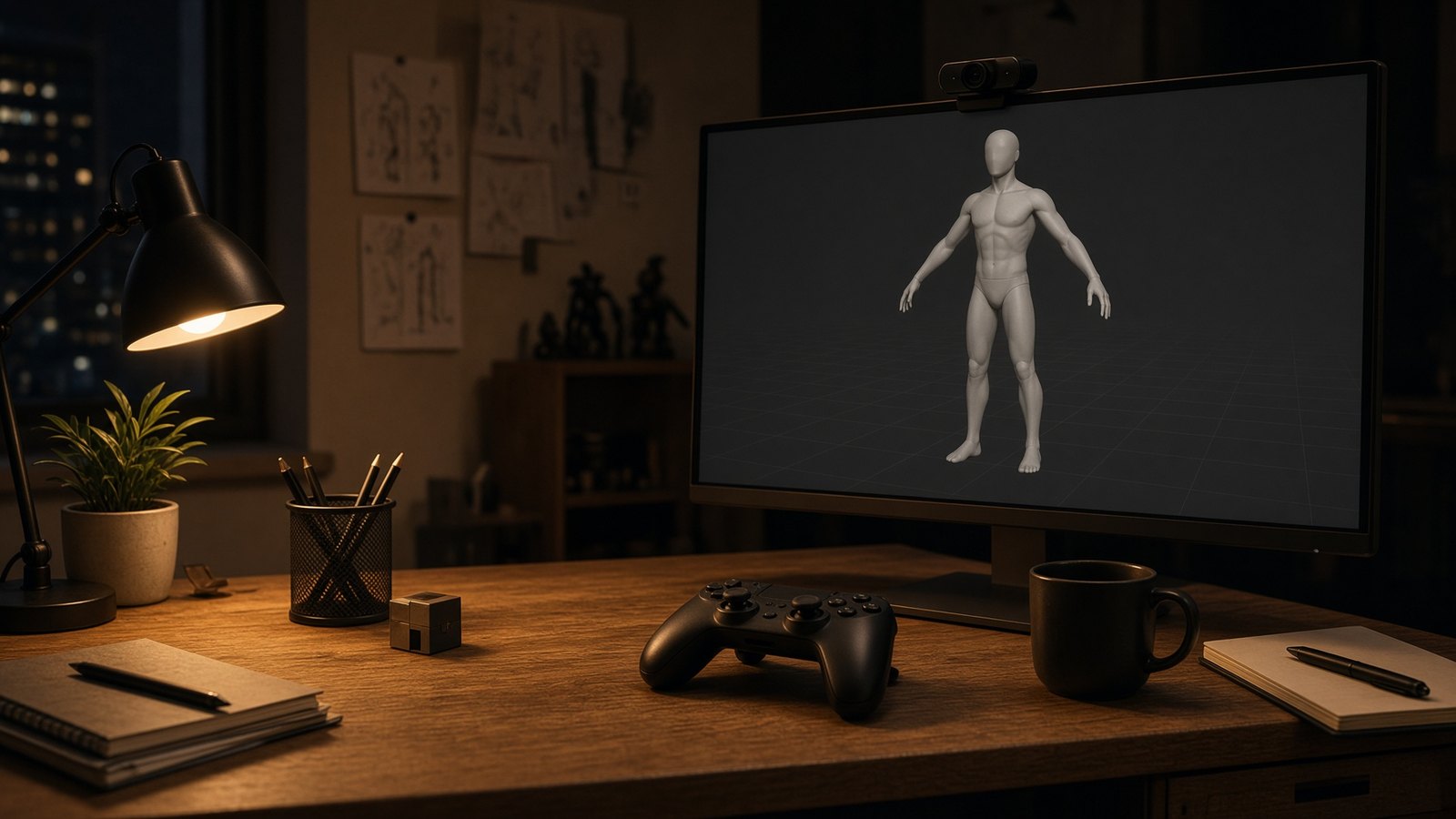
The cost story in independent games in 2026 is not that a model ships the game. It is that a two- to ten-person studio can prototype 3D characters and animation that used to require a publisher's budget, while many of the people who make those games still say the tools are a net loss.
Rework's 2026 tool guide, citing The Business Research Company, projects the generative-AI gaming market from $1.79 billion in 2025 to $2.21 billion in 2026 and $5.09 billion by 2030. That is a forecast. The same guide cites a Google Cloud and Harris Poll survey of 615 developers in which 90 percent said they use AI in their workflow and 97 percent said it is reshaping the industry. A 2026 Game Developers Conference survey of more than 2,300 professionals, also via Rework, found 36 percent using generative AI day to day, against 58 percent in publishing and marketing roles. The uses they named most were playtesting and balancing (47 percent), localization (45 percent), and code generation (44 percent). Fifty-two percent viewed the overall impact as negative, including 64 percent of visual artists and 59 percent of programmers.
The price gaps in the asset pipeline are vendor comparisons, and they are large. Rework says Kaedim advertises up to a 90 percent cut in 3D asset cost, at indie tiers of $29 to $99 a month, and that Meshy's $20-a-month plan cites 60 percent faster background props. Reallusion Magazine says outsourcing one production-ready character still runs $3,000 or more and can take weeks. Its guide quotes Rendeo chief executive Radim Bacik saying a single high-end character used to occupy 12 people for a week, and that pairing Character Creator with an AI-assisted workflow cuts that time by five to ten times.
Motion capture is the starkest line item in StraySpark's 2026 comparison: optical stages from $50,000 to more than $500,000, studio rentals of $2,000 to $5,000 a session, outsourced scenes of $3,000 to $8,000, and inertial suits of $5,000 to $25,000. The same comparison puts video-based tools such as DeepMotion, Cascadeur, Rokoko Video, and Unreal's MetaHuman Animator in a range from free tiers to about $20 to $40 a month, using a webcam, with claimed major-joint accuracy of 2 to 3 centimeters. That accuracy figure is the comparison site's, not a lab standard.
One studio published its own time sheet. Althera Games, writing in May and updating the post on June 23, 2026, said routine C++ gameplay systems were about 38 percent faster with AI assistance and novel architecture only about 12 percent faster, because engineers still had to design the system. Converting a Blueprint of more than 200 nodes into C++ took 90 minutes instead of a workday. Concept exploration fell from three weeks to four days. The studio said it used synthetic voice and music only as placeholders, then hired people for the shipping audio. That is one team's measurement of its own process.
Platform rules are splitting tools that help production from content that ships. Rework reports that on January 17, 2026, Valve updated Steam's disclosure rules to exempt coding assistants when their output is not what the player receives. Itch.io's separate crackdown on shipped AI spam is about storefronts, not about whether a webcam rig replaced a $50,000 stage.