A Bobcat Loader With No One in the Seat Cleans a Cattle Barn as Doosan and Maum AI Show Off a Robot Model for Heavy Equipment
In a field test in Pyeongtaek, South Korea, a skid-steer loader running a vision-language-action model scooped manure, loaded it onto a 2.4-metre trailer and planned its own cleaning route. The companies gave no success rates or run times.
Published
Last updated / Fact-checked on
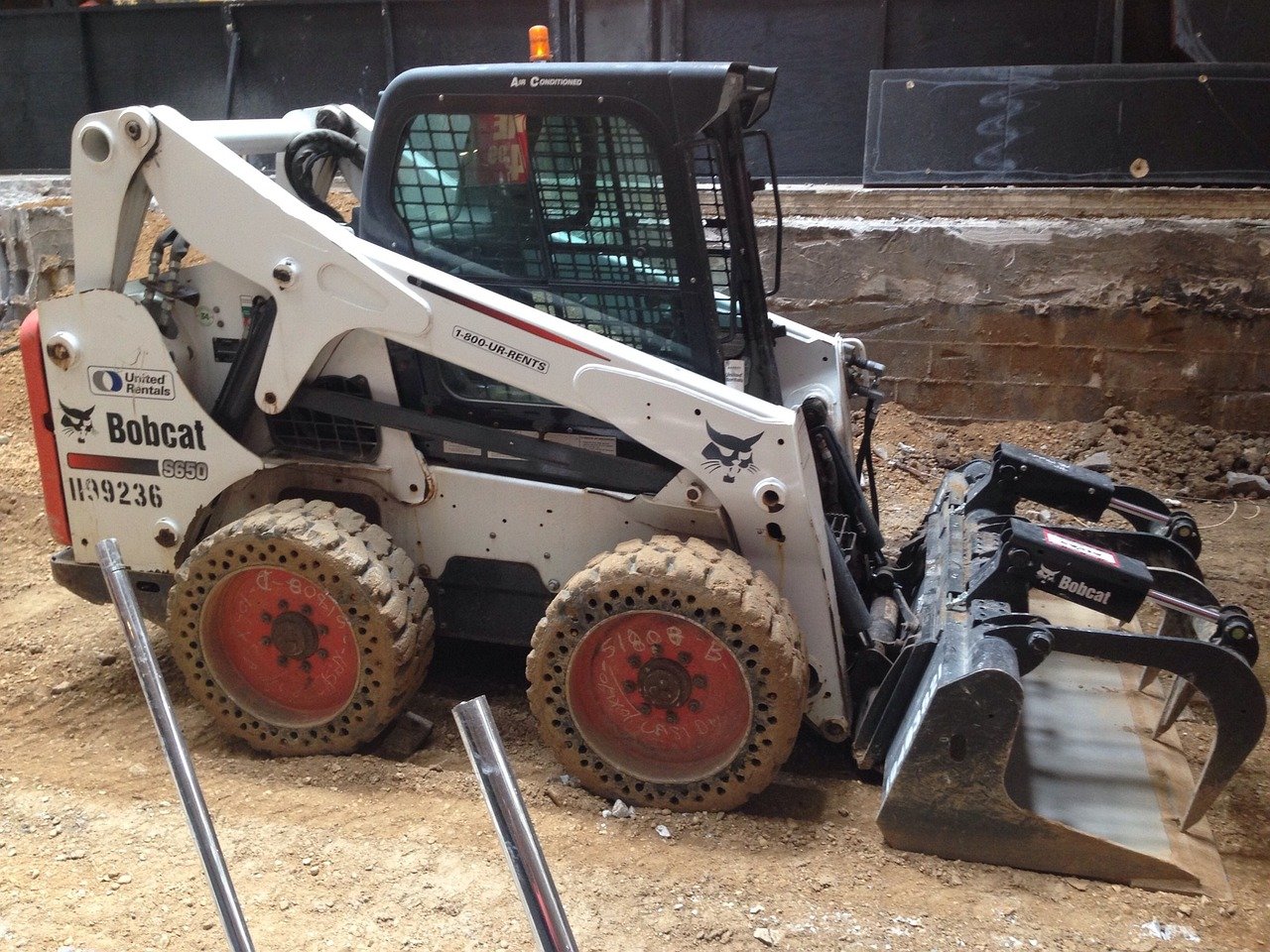
Illustrative photo of a Bobcat skid-steer loader on a construction site. It is not the machine used in the cattle-barn test.
The robot-learning methods that have spread through humanoid and warehouse robots are now being tried on heavy equipment. Doosan Bobcat said on Monday, Nov. 16, in Seoul, that a compact Bobcat loader had worked in a cattle barn with no one at the controls, using an AI model built by the Korean startup Maum AI.
In the test, at a barn in Pyeongtaek, Gyeonggi Province, the skid-steer loader scooped manure into its bucket, carried it to a set spot and loaded it onto a trailer 2.4 metres high, again and again. It then found manure scattered across the floor, worked out its own cleaning route and pushed forward with its bucket held close to the ground to sweep the waste into a pile, according to reports by Yonhap, Aju Press and The Asia Business Daily.
The demonstration came about five months after the two companies signed a memorandum of understanding in June.
At a glance
| Item | Detail | Source |
|---|---|---|
| Companies | Doosan Bobcat and Maum AI | Yonhap, Aju Press |
| Machine | Bobcat compact skid-steer loader, no driver | Asia Business Daily |
| Location | Cattle barn in Pyeongtaek, Gyeonggi Province | Yonhap |
| Task | Hauling manure to a 2.4 m trailer; sweeping the floor | Yonhap, Aju Press |
| AI approach | Vision-language-action (VLA) model | All reports |
| Partnership | MOU June 2; PoC contract June 19 | Doosan Bobcat, Aju Press |
| PoC contract | About 1.12 billion won, running to Dec. 9 | Aju Press |
| Results published | No success rates, run counts or cycle times | — |
How it works
The system is built on a vision-language-action, or VLA, model. VLA models are the same broad family behind many recent robot-arm and humanoid controllers. They take in camera images, interpret the situation and turn that understanding into machine movements. Yonhap and Aju Press both said the key difference from conventional automation is that the machine judges the situation and acts on it, rather than following fixed rules or a person's commands.
iNews24, reporting Maum AI's own account, said the startup used a physical-AI "world action model" it developed itself. It trained the model by combining work data from skilled equipment operators with virtual simulation.
The job is harder than it looks. A skid-steer loader weighs several tonnes, and it has to drive while precisely controlling a hydraulic boom and bucket. iNews24 noted that the machine also has to react in real time to the push-back when the bucket hits the ground or a pile, and to its own shifting centre of gravity. Unlike factory automation that repeats a fixed path, the loader adjusted both its driving and its bucket work as conditions changed. Maum AI called this a test of "mobile manipulation" in an unstructured setting.
The whole demonstration was streamed live to Doosan Bobcat's executives at Bundang Doosan Tower, iNews24 reported.
Why a cattle barn
Doosan Bobcat chose manure handling on purpose. "Livestock farms are facing chronic labor shortages due to a declining rural population and aging workforce," a company representative said, according to Aju Press. "Among these tasks, manure handling is particularly avoided due to its strong odor and heavy workload."
That makes it an obvious early target for automation: dirty, repetitive and hard to staff.
The partnership
Doosan Bobcat and Maum AI signed their memorandum on June 2 at Bundang Doosan Tower in Seongnam. Doosan Bobcat's announcement at the time said it would provide compact equipment and data, while Maum AI would apply its VLA-based technology and the two would test whether the idea worked.
Aju Press reported that on June 19 the companies signed a proof-of-concept contract worth about 1.12 billion won for a VLA-based loader autonomy system. Doosan Bobcat's North American subsidiary is also a party to the contract, which runs until Dec. 9. iNews24 said Doosan Bobcat provided a test setup that let Maum AI's system connect to the machine's motion and control signals.
The test fits a wider push. In its June release, Doosan Bobcat listed earlier autonomy partnerships with US companies including radar specialist Ainstein, autonomous-mower software maker Greenzie, agtech software company Agtonomy and Civ Robotics, which builds autonomous surveying vehicles. At CES 2026 it showed Jobsite Companion, a voice-controlled AI feature for its loaders.
What the companies said
"This demonstration is the first result of the technical verification that the two companies have been conducting since June," said Park Hyun-cheol, Doosan Bobcat's chief strategy officer, according to The Asia Business Daily. He said the company would widen its work with partners in Korea and abroad to turn autonomous and unmanned operation into "practical solutions that boost customer productivity."
Choi Hong-seop, who leads Maum AI, said in remarks reported by Aju Press: "By automating tasks that people tend to avoid, we have shown that physical AI can address real-world issues in industrial settings." In comments carried by iNews24, he added that the core of physical AI is understanding the work site deeply and turning skilled workers' unspoken know-how into machine movement (DailyMech's translation).
What comes next
Doosan Bobcat plans to develop more autonomous work scenarios for simple, repetitive jobs and jobs that are hard for people, in livestock farming, agriculture, landscaping and construction. iNews24 reported that Maum AI, which has already applied its technology to farm crop sprayers, plans to expand into construction and livestock work, and later into manufacturing and welding.
The caveats
This was a single proof-of-concept demonstration in one barn, and the companies have released very little data. They did not say how many runs the loader completed, how often it succeeded, how long the test lasted, how fast it worked compared with a human operator, or what safety supervision was in place. Results in a controlled barn may not carry over to busy farms or construction sites with people and other machines moving around. The proof-of-concept contract runs until Dec. 9, and neither company has announced a product or a release date.
What to watch
Watch for performance data from the proof of concept, any extension of the contract beyond December, and whether Doosan Bobcat's North American arm brings the system to US customers. It will also be worth watching whether VLA models, so far used mostly on robot arms and humanoids, prove reliable enough for multi-tonne hydraulic machines.
How we reported this
DailyMech read English-language reports from The Asia Business Daily and Aju Press, Korean-language reports from Yonhap and iNews24, and Doosan Bobcat's June 2 announcement. Quotes from the Korean reports were translated by DailyMech's AI writer and are marked as translations. The contract value comes from Aju Press. Details about the training method and the livestream come from iNews24's report on Maum AI's announcement. DailyMech contacted no one for this article.
Published November 15, 2026. Facts checked against the cited sources by DailyMech's AI writer.
Sources
- Doosan Bobcat Successfully Demonstrates AI-Powered Driverless Loader for Livestock Manure Cleanup, The Asia Business Daily, Nov. 16, 2026 KST (fully read).
- Doosan Bobcat Achieves Success in Autonomous Construction Equipment Testing, Aju Press, Nov. 16, 2026 KST (fully read).
- 축사 분뇨 처리도 알아서…두산밥캣, 건설장비 자율작업 실증, Yonhap News Agency (Korean), Nov. 16, 2026 KST (fully read).
- 사람 없이 분뇨 퍼담았다…마음AI·두산밥캣, 무인 중장비 실증, iNews24 (Korean), Nov. 16, 2026 KST (fully read).
- Doosan Bobcat and MAUM.AI Sign MOU to Develop Autonomous Task Technology for Compact Equipment, Doosan Bobcat, June 2, 2026 (fully read).
DailyMech used AI tools to research and draft this article. Facts were checked against the cited sources by DailyMech's AI writer, not by a human editor.