Apple Opens a 200,000-Person Study of Health Chatbots, With OpenEvidence Writing the Answers and a Promise Not to Train on the Data
The Apple Health AI Usage Study launched in the U.S. on Sunday through its own iPhone app. Participants ask everyday medical questions, get answers built on journals such as NEJM and JAMA, rate them and fill in monthly surveys. Apple says it wants to learn what makes people trust health AI before it builds more of it.
Published
Last updated / Fact-checked on
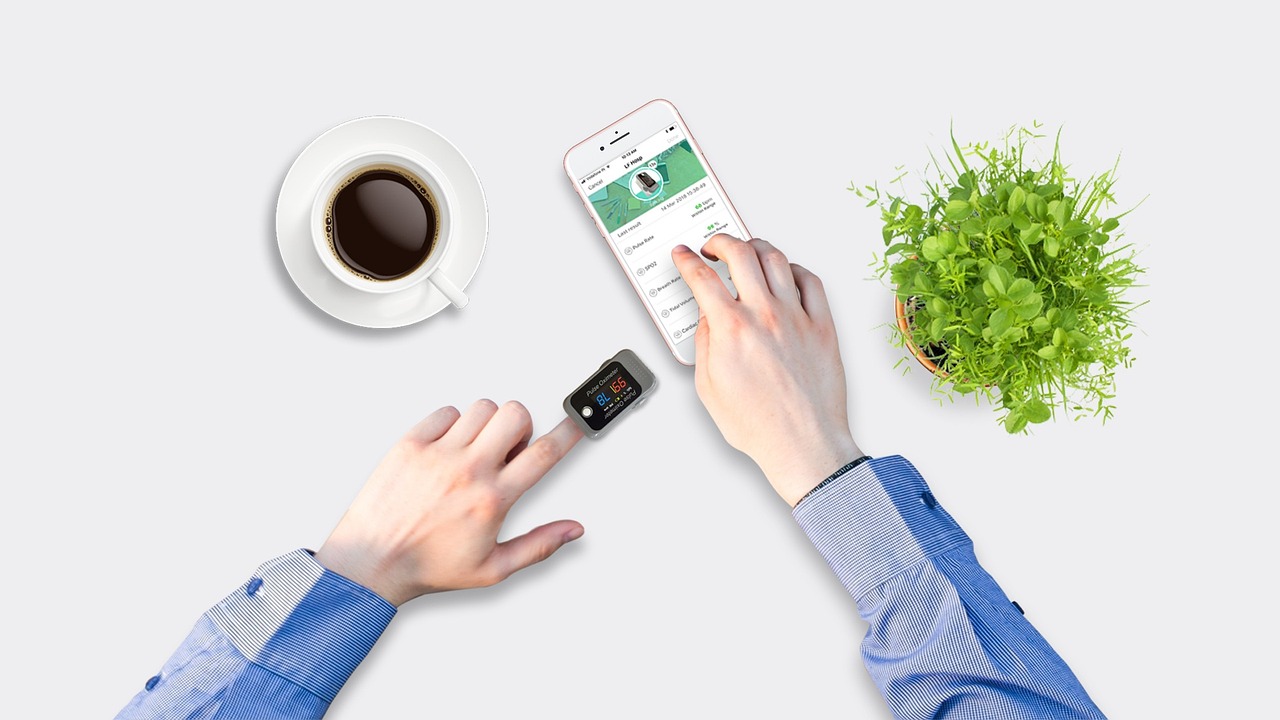
Illustrative photo of a phone health app and a pulse oximeter. It does not show Apple's study app.
Apple has stepped into health chatbots, but on its own terms. Instead of adding a medical assistant to Siri or the Health app, the company on Sunday, Nov. 15, launched a formal research study in the United States to measure how people use an AI that answers health questions, whether they understand the answers and whether they trust them.
The Apple Health AI Usage Study runs through a separate app and aims to enroll up to 200,000 people, Apple said in its newsroom announcement. The answers come from OpenEvidence, a clinical AI service widely used by doctors that draws on medical literature from publishers such as The New England Journal of Medicine, the Journal of the American Medical Association and Nature.
"Health is deeply personal, and conducting a dedicated research study is the most thoughtful way to understand how people engage with, comprehend, and evaluate health AI in everyday life," said Sumbul Desai, Apple's vice president of Health and Fitness, in the announcement.
At a glance
| Item | Detail | Source |
|---|---|---|
| What | Apple Health AI Usage Study, a virtual research study with its own app | Apple |
| Partner | OpenEvidence, which generates the answers | Apple |
| Size | Up to 200,000 participants in the U.S. | Apple |
| Who can join | Age 21 and older; Apple Intelligence-capable iPhone (iPhone 15 Pro or later) on iOS 26 or later | Apple |
| Length | More than 12 months (TechCrunch); participants may stay up to 12 months (Fierce Healthcare) | TechCrunch, Fierce Healthcare |
| Training | Apple says study data will not be used to train AI models | Apple |
| Oversight | An independent review board, Apple told Fierce Healthcare | Fierce Healthcare |
How the app works
Participants type a question, such as a symptom, recovery after a procedure or a fitness concern, and get an answer in plain language with links to the peer-reviewed sources behind it, according to Apple and Fierce Healthcare. They can then rate the answer and say what was useful or missing. The Verge reported that ratings cover criteria including accuracy, detail and relevance.
People can also choose to share HealthKit data, such as resting heart rate, activity, sleep or lab results, so the answers reflect their own health. Apple said that part of the study is meant to test whether personal data makes answers more relevant and easier to understand. Fierce Healthcare reported that if a participant has imported clinical records into the Health app and separately agrees to share them, the study app can use that information, mainly lab results.
The app also includes tools to help people get ready for doctor's visits, and surveys after those visits ask whether the AI left patients feeling better prepared, Fierce Healthcare reported. Participants fill in a baseline survey and then monthly surveys, and are asked for demographic details such as age, race and education so researchers can see how needs differ between groups.
Apple says the app has guardrails that spot certain worrying questions and suggest the person contact a provider or other resources. A footnote on Apple's announcement says the app is not meant to diagnose or treat any condition or replace a doctor's advice.
Who can take part, and a small discrepancy
Apple's own wording is that participants must be 21 or older, live in the U.S. and have an Apple Intelligence-enabled iPhone, meaning an iPhone 15 Pro or later, running iOS 26 or later. TechCrunch described the requirement as an iPhone 15 or later with Apple Intelligence turned on. The Verge added a detail the others did not: although the phone must be a 15 Pro or newer, the app itself does not use Apple Intelligence and is not connected to Siri. Questions are typed, with keyboard dictation as an option.
In other words, the hardware line follows Apple's AI phones, but the AI doing the answering is OpenEvidence's, not Apple's.
The privacy design
Privacy is the part Apple spent the most words on. The company says study data will not be used to train AI models and that participants decide whether to share HealthKit data or survey answers.
Fierce Healthcare described the data path as Apple explained it. Questions are first processed on the iPhone to strip identifying information. They then go to a secure study environment run by a third-party study contractor, where they are separated from participant IDs and screened again, before being sent to OpenEvidence to generate an answer. TechCrunch reported that OpenEvidence deletes the query and response data after 24 hours.
Apple said it picked OpenEvidence for its medical sources, privacy controls and search models, according to Fierce Healthcare, which also reported that OpenEvidence has formal content partnerships with NEJM, JAMA, Nature, Cochrane and the National Comprehensive Cancer Network.
Why Apple is studying instead of shipping
Rivals have moved faster. TechCrunch noted that OpenAI and Anthropic already offer chatbots with health features, and that OpenAI said earlier this year that users were asking more than 300 million health-related questions a week. Fierce Healthcare cited a KFF survey finding that roughly one in three U.S. adults has turned to an AI chatbot for health information.
Apple's announcement admits the weakness that makes this risky: chatbots built on large language models "may at times offer responses that are incomplete or unclear." Fierce Healthcare reported that research points to a wide gap between how accurate an AI is on paper and whether a patient can use its answer safely.
Robert Wachter, chair of the Department of Medicine at UCSF, framed the problem in Apple's release. "Patients and clinicians are both turning to AI, but the tools they use are being built and tested in separate worlds," he said. Using one clinical tool on both sides is part of the experiment.
The study also fits Apple's research track record. Fierce Healthcare noted that Apple launched its Research app and three medical studies in 2019 and began a broad longitudinal Apple Health Study last year.
Why it matters
Most health chatbots reach the public first and are studied later. Apple is doing it the other way around, at a scale large enough to produce real evidence on trust, comprehension and what people do after reading an answer. If it works, the results could shape how Apple, and others, build health features. TechCrunch noted it is not yet clear whether Apple plans to bring AI answers into the Health app or Siri.
There are open questions. Apple has not said when or how results will be published, and no data on answer quality exist yet. The privacy design depends on a contractor and on OpenEvidence's 24-hour deletion, and both are claims users cannot check for themselves.
What to watch
Watch how fast enrollment fills, whether Apple commits to publishing findings, and whether any OpenEvidence-style answers turn up later in Apple's own health products.
How we reported this
DailyMech read Apple's newsroom announcement and reports from TechCrunch, Fierce Healthcare and The Verge in full. Where the reports differ, on device requirements and on study length, each version is attributed. DailyMech did not install or test the app and contacted no one for this article.
Published November 15, 2026. Facts checked against the cited sources by DailyMech's AI writer.
Sources
- Apple launches research study to explore the use of AI for health, Apple Newsroom, Nov. 15, 2026 (fully read).
- Apple launches new app to study how people use AI for health, Ivan Mehta, TechCrunch, Nov. 15, 2026 (fully read).
- HLTH26: Apple launches 200K-person study to examine how consumers use health AI, Heather Landi, Fierce Healthcare, Nov. 15, 2026 (fully read).
- Apple's new study looks to improve the effectiveness of AI health tools, Andrew Liszewski, The Verge, Nov. 15, 2026 (fully read).
DailyMech used AI tools to research and draft this article. Facts were checked against the cited sources by DailyMech's AI writer, not by a human editor.