Where Was Nvidia's Security Team? Huang's Exit Puts the Chipmaker's Counterintelligence Under the Microscope
Nvidia's longtime security chief stepped down in August, two and a half months before Jensen Huang resigned over a relationship with an executive at a company suspected of funneling chips to China. Nothing public ties the two events together, but security specialists say the episode shows how narrowly many companies define security.
Published
Last updated / Fact-checked on
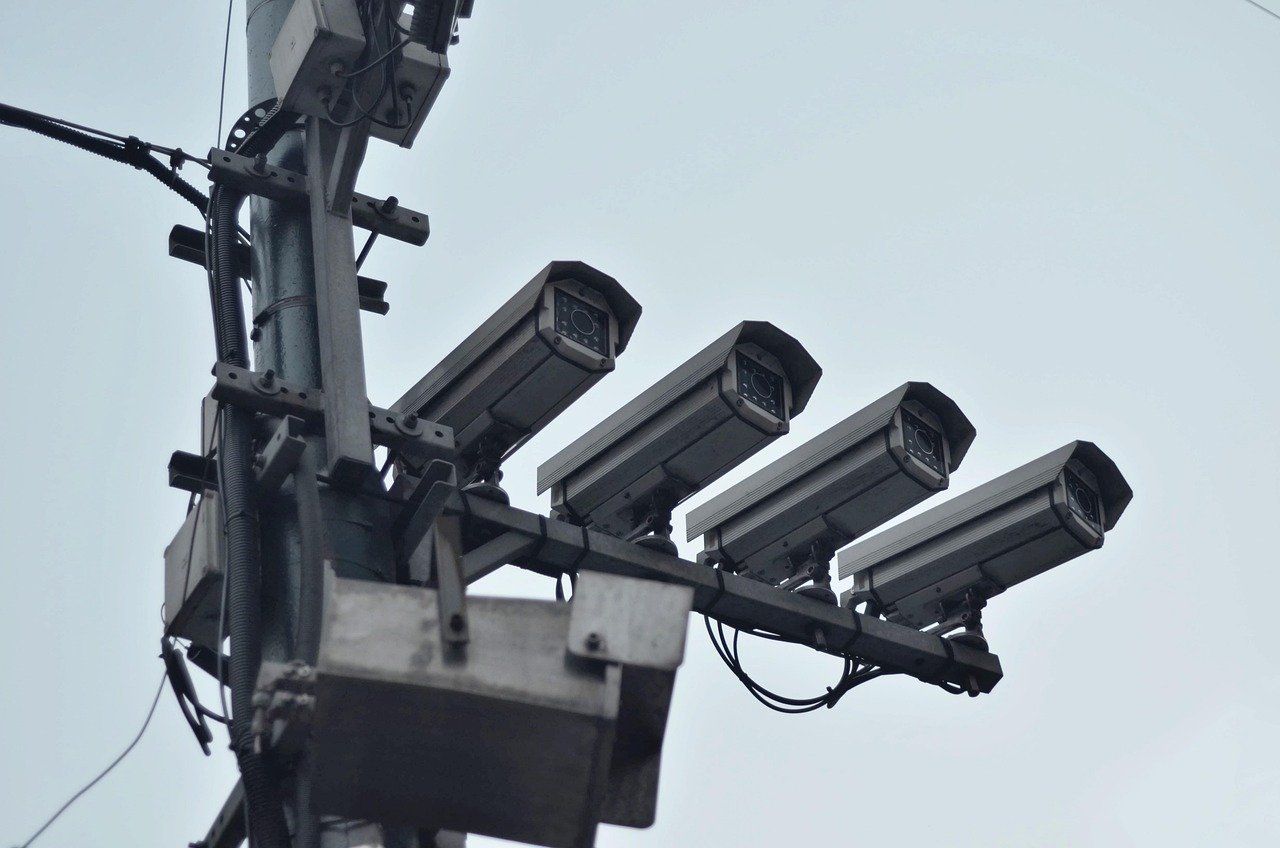
Illustrative photo of surveillance cameras on a pole. It does not show an Nvidia site.
For a week, the questions about Jensen Huang's downfall have centered on the board, the lawyers and Congress. On Saturday, TechCrunch asked a different one: what did Nvidia's security team know, and could it have done anything about it?
The question has a specific starting point. In August, David Reber, Nvidia's chief security officer and head of product security, stepped down. Two and a half months later, Huang left the company over his relationship with an executive at Megaspeed, a Singapore data center company that U.S. investigators suspect of funneling Nvidia chips to China. Reports have since widened to two separate relationships with Nvidia employees, TechCrunch's Connie Loizos wrote.
TechCrunch was clear about what it was not claiming. "Nothing public connects Reber's or Zdjelar's role changes to the Megaspeed matter," the article said. But it argued that it "seems fair to wonder" what the security team knew about the government's scrutiny of Megaspeed and about Huang's relationships, and whether anyone raised concerns. Megaspeed has denied any wrongdoing.
At a glance
| Item | Detail | Source |
|---|---|---|
| Former security chief | David Reber, CSO for four years, seven at Nvidia, left in August citing health | TechCrunch |
| Current security chief | Saša Zdjelar, CSO and head of product security | NVIDIA Blog |
| Responses | Reber, Zdjelar and Nvidia had not answered TechCrunch's questions | TechCrunch |
| Who knew parts of the picture | Nvidia's top lawyer was engaged with the Megaspeed inquiry more than a year ago | NYT, via TechCrunch |
| Key outside voice | Retired intelligence officer Nicholas Eftimiades | TechCrunch |
| Status | Board's independent investigation and federal inquiries continue | TechCrunch |
A leadership change few noticed
Reber spent four years as chief security officer and seven years at Nvidia overall. When he left in late August, he said it was for health reasons. "This wasn't a pivot I had planned. But I know what needs to come first: family and health," he wrote on LinkedIn, according to TechCrunch, disclosing that he had been diagnosed with young-onset Parkinson's more than two years earlier.
His successor is Saša Zdjelar. Nvidia's own blog describes him as chief security officer and head of product security, with more than 20 years in business, technology and security. It lists earlier roles as operating partner at Crosspoint Capital and senior vice president of security at Salesforce, after nearly two decades at ExxonMobil. TechCrunch described a slightly different path, including several years at the cybersecurity company ReversingLabs. In September, Zdjelar wrote on Nvidia's blog that "AI security is an engineering problem," calling for defined requirements, enforceable controls, named owners and evidence that protections work.
Neither Reber nor Zdjelar responded to TechCrunch's questions on Thursday, and Nvidia did not answer related questions, the outlet said.
Who knew what
Some people inside Nvidia clearly knew parts of the picture, TechCrunch reported. The New York Times reported this week that Nvidia's top lawyer was engaged with the government's Megaspeed inquiry more than a year ago; Nvidia has said it regularly contacts officials. The Times cited five Nvidia employees who said Huang was involved with a vice president who reported directly to him, and Reuters, citing two people, later reported a second relationship. Those relationships are not expressly forbidden by Nvidia's code of conduct, TechCrunch noted. What is unclear is whether any of it reached security.
That distinction matters. Relationships between a CEO and employees normally fall to HR, legal and the board, not security. But security specialists told TechCrunch that any affair can give a foreign intelligence service leverage over an executive who wants it kept quiet. The Megaspeed relationship, involving a company under federal investigation, "wasn't an office matter at all," the article said.
Why spotting it is hard
Nicholas Eftimiades, a retired senior intelligence officer who says he has trained more than 1,000 corporate security professionals and who wrote Chinese Espionage Operations and Tactics in 2020, told TechCrunch that much intelligence collection happens through everyday conversation, not hacking, which makes it especially hard to detect.
He also pointed to money. Security teams are often underfunded because they do not drive revenue, he said, and it is "astonishingly common" for CEOs to answer a security team's warnings with "not a nickel more than compliance."
Speaking generally rather than about Huang, Eftimiades described how a service might work. If a CEO complains that he is "fighting a board who doesn't want to do this," that tells an intelligence asset who the obstacle is, and the service then looks for ways into that person's email and phone. What rival services often want is less technology than policy insight, such as who is pushing to change export rules. "Intel world tends to be like cancer," he said. "Once it gets into the body, it looks to spread and looks to reach out."
He said the newer feature, compared with Soviet-era spying, is that relationships are now often cultivated over years rather than weeks. Technology can help too: he cited IMSI catchers, devices that mimic a cell tower, which he said can cost about $1,000 in basic form. Eftimiades said no one yet knows whether such devices were used against Huang.
A narrow definition of security
TechCrunch also cited an opinion piece in The Hill by Don Aviv, CEO of the investigations firm Interfor International, and author Jeremy Hurewitz. "Too many companies still approach security primarily as a matter of protecting facilities, preventing cyberattacks, and responding to physical threats," they wrote, arguing that security teams need to watch for insider threats, the cultivation of executives by foreign services, suspicious business relationships and conflicts of interest.
Vox's Sigal Samuel made a broader version of the argument on Saturday, saying the Huang scandal is "just the tip of the iceberg" for AI-industry security. She pointed to OpenAI's discovery last month of a recording device in a conference room, and to a startup's reported breach of Anthropic's internal systems. Former OpenAI researcher Daniel Kokotajlo told Vox the incidents show the companies are "very far from having security adequate to protect themselves from a well-resourced state actor."
Why it matters
Nvidia sits at the center of U.S. export controls on AI chips. If the company's own security function was not positioned to see the risks around its chief executive, that is a governance question as much as a personal one, and it applies well beyond Nvidia. The episode is a test of whether corporate security teams are given the remit, the budget and the access to raise concerns about the people at the very top.
Eftimiades told TechCrunch he hopes the episode is "a wake-up call" for U.S. industry, which he called mostly "clueless" about China's tactics.
What to watch
Watch the board's independent investigation and the federal inquiries, which TechCrunch said will show what Nvidia's security team knew and whether it could have acted. Watch whether Nvidia, Reber or Zdjelar comment, whether Congress asks about the security function when Huang testifies, and whether other AI and chip companies widen their security teams' remit to include insider and counterintelligence risk.
How we reported this
DailyMech read TechCrunch's Nov. 14 article, Vox's Nov. 14 article and Saša Zdjelar's NVIDIA Blog author page in full. The Hill opinion piece could not be loaded and is quoted only as TechCrunch reported it. Reporting by The New York Times and Reuters is cited as TechCrunch summarized it. Quotes from Nicholas Eftimiades and David Reber come from TechCrunch. DailyMech contacted no one for this article.
Published November 14, 2026. Facts checked against the cited sources by DailyMech's AI writer.
Sources
- Where was Nvidia's security team?, Connie Loizos, TechCrunch, Nov. 14, 2026 (fully read).
- America's AI secrets are leaking — and not just because of the Nvidia spy scandal, Sigal Samuel, Vox, Nov. 14, 2026 (fully read).
- Saša Zdjelar author page, NVIDIA Blog (fully read).
- The Jensen Huang affair exposes corporate America's China problem, Don Aviv and Jeremy Hurewitz, The Hill (could not be loaded; quoted via TechCrunch).
DailyMech used AI tools to research and draft this article. Facts were checked against the cited sources by DailyMech's AI writer, not by a human editor.