Hong Kong's Airport Hands Runway Painting to Robots, Cutting a Three-Hour Night Job to One Hour
Two satellite-guided 'Brushman' robots, adapted from sports-field line markers with Shenzhen's FJ Dynamics, have been repainting runway markings at Hong Kong International Airport since September. The Airport Authority calls it a world first, says the robots now handle more than half of the routine marking work, and plans a fleet of six.
Published
Last updated / Fact-checked on
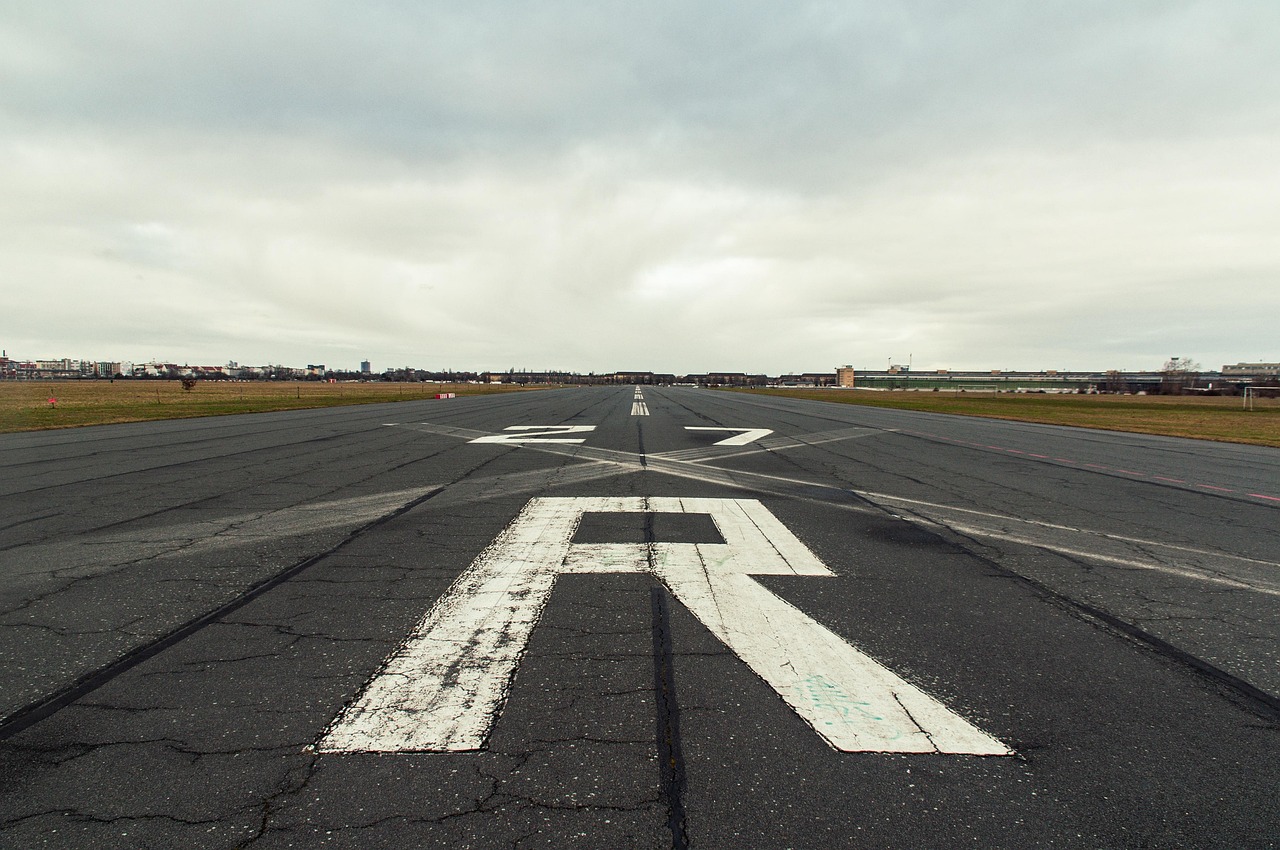
Illustrative photo of runway markings. It does not show Hong Kong International Airport or the painting robots.
Hong Kong International Airport is using robots to repaint the markings on its runways, a job that used to need a crew of more than 20 people working through the night. The Airport Authority said at a media briefing this weekend that it is the first airport in the world to do so, according to The Standard, RTHK and the South China Morning Post.
The robots have been working since September. Repainting a runway centre line by hand took about three hours, and a robot now does it in about one, said Steven Yiu Siu-chung, the authority's chief operating officer. Overall working time has fallen by roughly two-thirds, he said. The Post put the time saving for centre lines at about 67 per cent.
"It is a job of huge physical labour and precision. Also, the job is at nighttime and requires precision when everyone is tired," Yiu said at a media briefing, RTHK reported. "In terms of accuracy and safety, we hope that machines can assist humans."
At a glance
| Item | Detail | Source |
|---|---|---|
| Robots | Two: a dual-nozzle unit for straight lines, a single-nozzle unit for corners | The Standard |
| Partner | FJ Dynamics, Shenzhen | The Standard |
| In service since | September 2026 | The Standard, RTHK |
| Centre-line repaint | About 3 hours by hand, about 1 hour by robot | RTHK, The Standard |
| Positioning | Four satellite systems plus RTK ground stations; 1-2 cm accuracy | The Standard |
| Share of routine work | More than half | The Standard, RTHK |
| Paint savings | About 40% a year, or about HK$400,000 a year | The Standard; RTHK |
| Fleet plan | Six robots | The Standard, RTHK |
Why runway paint is a hard job
The airport has three runways, each 3,800 metres long. Each one carries thresholds, aiming points, touchdown zones and a centre line, The Standard reported. RTHK put the markings across the three runways at more than 11 kilometres.
The centre line wears out fastest because aircraft nose wheels keep rolling over it on landing, so it has to be repainted every week. Other markings are redone every two to six months, according to The Standard. Each runway's centre line is made up of more than 100 separate stripes, the Post reported.
The work can only happen late at night, when traffic is light enough to close a runway for maintenance. Until now that meant more than 20 workers outdoors through the night, sometimes in winter rain, and the authority has also struggled to find skilled staff, The Standard reported.
How the robots work
The authority worked with FJ Dynamics, a technology company in Shenzhen, to adapt machines first built to paint lines on sports fields, The Standard and RTHK reported. There are two robots. One has two nozzles and paints straight lines. The other has a single nozzle and handles corners.
To stay on the line, the robots take signals from four satellite navigation systems: America's GPS, China's BeiDou, Europe's Galileo and Russia's GLONASS. They also use real-time kinematic positioning, which corrects those signals using fixed reference stations on the ground, The Standard reported. The authority says this gets accuracy down to 1 to 2 centimetres.
A robot locks onto the coordinates of a marking's corners, drives to them and paints the straight sections by itself, pausing between lines. Lidar scans the area around it for obstacles and people, according to The Standard. The Post described the machines as AI-powered.
The robots had to pass tests before they touched a live runway. The Standard said they went through nine months of trials, met International Civil Aviation Organization standards and were approved by Hong Kong's Civil Aviation Department. RTHK said the testing took a year.
Less paint, but people stay
The authority says the robots spray more precisely than people with spray guns. The Standard reported that this saves about 40 per cent of paint each year. RTHK quoted Yiu as putting the saving at about HK$400,000 a year in paint alone.
The robots now do more than half of the airport's regular, repetitive marking work. Curves and more complicated markings are still painted by hand, The Standard and RTHK reported.
Yiu said the goal is not to replace the crews. Front-line workers will gradually become robot operators and supervisors, and runway maintenance will not become fully unmanned because staff are still needed for safety and emergency response, The Standard reported. The authority plans to grow the fleet to six robots, and Yiu said he hopes robot painting will become standard practice in civil aviation.
Why it matters
Most talk about robots at airports is about baggage handling or check-in kiosks. This is a quieter, more practical use: a heavy, repetitive outdoor job that has to be done precisely, at night, often by tired crews. Runway markings are safety equipment, since pilots use them to line up for take-off and landing.
The project also shows how a lot of robotics is reaching real work. It is not a humanoid or a new invention. It is an existing machine from another industry, sports-field marking, adapted with satellite positioning and safety sensors and then put through aviation approval. Airports with long runways and labour shortages are likely to watch the results closely.
There are still gaps. The authority did not disclose what the robots cost, how many hours they have logged, or how their painting compares with human crews when measured by inspectors. The "world first" claim comes from the authority and DailyMech could not check it independently.
What to watch
Watch whether Hong Kong reaches its six-robot fleet and whether the robots take on curved markings. Watch for other airports, especially in mainland China and the rest of Asia, adopting the same system, and for any move by aviation regulators to write robot painting into standards, as Yiu hopes.
How we reported this
DailyMech read The Standard's and RTHK's reports on the Airport Authority's briefing in full. The South China Morning Post's report was read only up to its paywall, and the details taken from it are attributed. Where the sources differ, on testing time and on how paint savings are measured, both versions are given. DailyMech contacted no one for this article.
Published November 15, 2026. Facts checked against the cited sources by DailyMech's AI writer.
Sources
- HK airport introduces automatic runway-painting robots in world first, The Standard, Nov. 15, 2026 (fully read).
- 'Runway painting robots save time, money', RTHK, Nov. 15, 2026 (fully read).
- Fresh coat, lighter load: Hong Kong airport puts runway-painting robots to work, South China Morning Post, Nov. 15, 2026 (read to paywall).
DailyMech used AI tools to research and draft this article. Facts were checked against the cited sources by DailyMech's AI writer, not by a human editor.