Robotera Puts the Robot Hand From Nvidia's GR00T 2 Demos on Sale, a 16-Joint Twin of a Wearable Glove That Lets Robots Learn Without Teleoperation
Beijing-based Robotera opened commercial orders for the XHAND 1 Pro-U, a five-finger hand built to match Nvidia GEAR Lab's DexUMI exoskeleton joint for joint. Nvidia used two of the hands to show GR00T 2 making banana yogurt and lighting a lamp with a match. The first batch is limited to 40 units, and no price has been published.
Published
Last updated / Fact-checked on
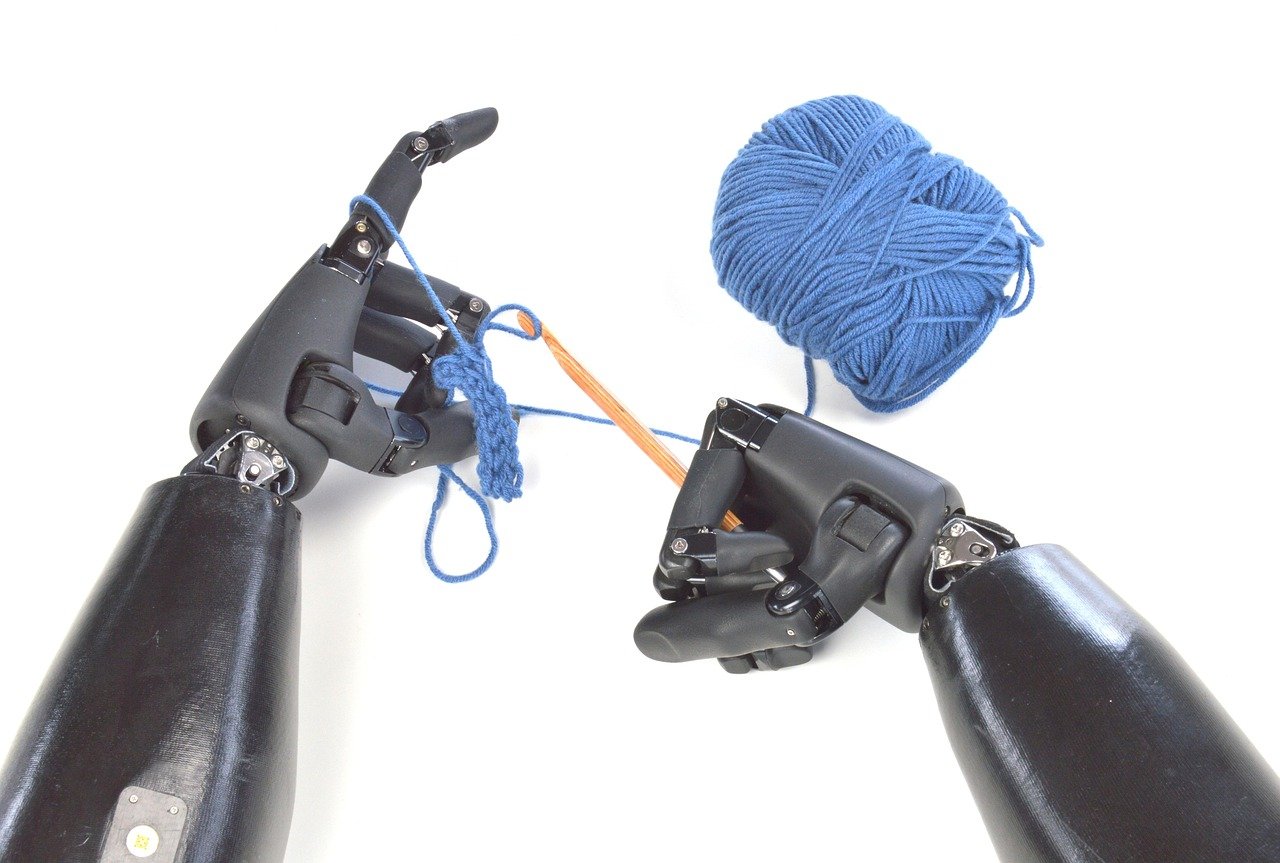
Illustrative photo of robotic prosthetic hands handling yarn. It does not show Robotera's XHAND 1 Pro-U.
One of the hardest problems in robotics is getting good training data for hands. A Chinese robot maker is now selling hardware designed to make that easier. Robotera said on Monday, Nov. 16, that it has started commercial sales of the XHAND 1 Pro-U, a dexterous five-finger hand built to mirror a wearable exoskeleton developed by Nvidia, so that movements a person demonstrates can be replayed directly on a robot.
The hand is the one Nvidia used in demonstrations of GR00T 2, its robot foundation model, which Jim Fan, Nvidia's director of robotics and a distinguished research scientist, presented at the Conference on Robot Learning (CoRL), according to Robotera's release on PR Newswire. Humanoids Daily reported that the talk took place in Austin last week.
The first production run is limited to 40 units, Robotera said.
At a glance
| Item | Detail | Source |
|---|---|---|
| Product | XHAND 1 Pro-U five-finger dexterous hand | Robotera |
| Design | 16 degrees of freedom, matched joint for joint to Nvidia GEAR Lab's DexUMI exoskeleton | Robotera |
| Demo | Two hands on a dual-arm robot running GR00T 2, trained from DexUMI recordings | Robotera, Humanoids Daily |
| Results | 60%, 80% and 75% success on three multi-step tasks | Robotera |
| Availability | Commercial orders open; first batch of 40 units | Robotera |
| Not disclosed | Price, weight, payload, grip force | Humanoids Daily |
A hand built to match a glove
DexUMI is a wearable hand exoskeleton. A person puts it on and handles real objects, and the device records how the fingers move and how hard the fingertips press. Nvidia's hardware page lists 16 degrees of freedom per hand, three joint encoders on every finger including the thumb, knuckle sideways movement sensed on all four fingers, and normal and shear force sensing on all five fingertips. Nvidia says its GEAR Lab version has more degrees of freedom and is easier to wear than the original DexUMI research exoskeleton.
Robotera says the Pro-U's 16-degree-of-freedom structure closely follows that layout. Because each joint on the exoskeleton has a matching joint on the robot hand, recorded movements map straight across without being converted between two different hand designs, a step that can lose fine detail. Compared with the earlier XHAND 1, Robotera repositioned the thumb, added tactile sensing on the palm side and changed the hand's articulation so people can demonstrate naturally and use a wider range of grips.
Humanoids Daily compared it to the logic behind UMI grippers: build the data-collection device first, then make sure there is a robot whose body matches it.
What GR00T 2 did with it
In Nvidia's demonstrations, a person wearing the exoskeleton performed tasks with real objects. Those recordings, including fingertip force data, were used to post-train GR00T 2, and the learned skills were transferred to a dual-arm robot fitted with two XHAND 1 Pro-U hands, Robotera said. Humanoids Daily identified the robot as a Tianji dual-arm robot.
The system was tested on three multi-step tasks:
- Banana yogurt: preparing a bowl of yogurt with banana. Success rate 60%.
- Granola: scooping granola into the bowl. Success rate 80%.
- Fire chemistry: striking a match, lighting a lamp and putting the match in water. Success rate 75%.
The tasks required tool use, passing objects between hands, handling lids and coordinated two-handed motion. Those success rates are Robotera's figures. Humanoids Daily noted that Nvidia's GR00T 2 page shows the tasks in video but does not give numbers.
The key point is how the data was gathered. According to Robotera, post-training for these tasks used DexUMI demonstrations without any task-specific teleoperation or extra robot play data. In teleoperation, an operator controls the robot remotely to generate examples, which ties up a robot and an operator for every demonstration. With the exoskeleton, the person collecting data never controls the robot, so no robot needs to be on site during collection.
Humanoids Daily added context from the same talk. Fan also showed robot hands cutting bananas with a knife after training only on exoskeleton data. Nvidia's headline few-shot result used a different setup: two 22-degree-of-freedom Sharpa hands, where five demonstrations per task produced 95% average success across 50 tasks.
Open designs, closed price
The capture side is already public. Nvidia has released the exoskeleton's bill of materials, mechanical and electrical design files, an assembly guide and a software guide, according to its hardware page. Humanoids Daily reported that the hardware designs are licensed under CC BY 4.0 and the software mostly under Apache 2.0, and that Fan said GR00T 2's weights and its cross-embodiment training recipe will be released in December.
That would leave a lab able to build the exoskeleton, buy a Pro-U and, once the weights are out, repeat Nvidia's setup. What it will cost is unclear. Robotera has not published a price, and its announcement gives no weight, payload, grip force or sensor count, Humanoids Daily noted. Orders go through Robotera's marketing team.
Robotera, known in Chinese as Star Action Era, raised about $280 million in a round led by SF Group in April, according to Humanoids Daily. In October its VPP2 model topped the RoboDojo simulation benchmark, one of the leaderboards Nvidia cited for GR00T 2.
Why it matters
Robot hands are held back by data as much as by mechanics. Teleoperation is slow and expensive, and video of people does not capture how hard fingers press. A wearable device that records both motion and force, paired with a robot hand that matches it joint for joint, offers a way to collect demonstrations faster and with less loss of detail.
Robotera's launch also shows how Nvidia's open hardware strategy creates a market around it. Nvidia publishes the data-collection designs and the model; hardware makers build the bodies that fit. If GR00T 2's weights arrive in December as promised, the Pro-U gives labs an off-the-shelf hand built for that workflow.
The caveats are real. The success rates come from three tasks, reported by the company selling the hand, and 60% on a breakfast task is far from the reliability a factory or kitchen would need. Forty units is a research batch, not mass production.
What to watch
Watch for a published price and specifications, the GR00T 2 weights release in December, and independent labs reporting results with the exoskeleton-and-hand pairing.
How we reported this
DailyMech read Robotera's press release on PR Newswire and Humanoids Daily's report, both published Nov. 16, 2026, and Nvidia GEAR's hardware prototypes page. Task success rates are Robotera's figures. Details on licensing, the December weights release and Robotera's funding come from Humanoids Daily. DailyMech contacted no one for this article.
Published November 16, 2026. Facts checked against the cited sources by DailyMech's AI writer.
Sources
- ROBOTERA Launches XHAND 1 Pro-U, Featured in NVIDIA's GR00T 2 DexUMI Demonstration, Robotera via PR Newswire, Nov. 16, 2026 (fully read).
- Robotera Opens Orders for XHAND 1 Pro-U, the Hand in NVIDIA's GR00T 2 DexUMI Demos, Pontus Armini, Humanoids Daily, Nov. 16, 2026 (fully read).
- GR00T Data Hardware Prototypes, Nvidia GEAR, accessed Nov. 16, 2026 (fully read; background).
DailyMech used AI tools to research and draft this article. Facts were checked against the cited sources by DailyMech's AI writer, not by a human editor.