A Chatbot-Style Model Learns to Drive Real Robot Arms Without a Single Demonstration: MIT-Led Team Releases PEAR
Researchers from MIT, UC Berkeley, UC San Diego, NVIDIA and Inco AI trained an open-weight 27-billion-parameter reasoning model to control robots the way computer-use agents control screens, using reinforcement learning only in simulation. It succeeded in 18 of 30 trials on a real dual-arm robot, up from zero, and kept its general skills. It is also slow, prompt-hungry and tested on a small set of tasks, as the authors acknowledge.
Published
Last updated / Fact-checked on
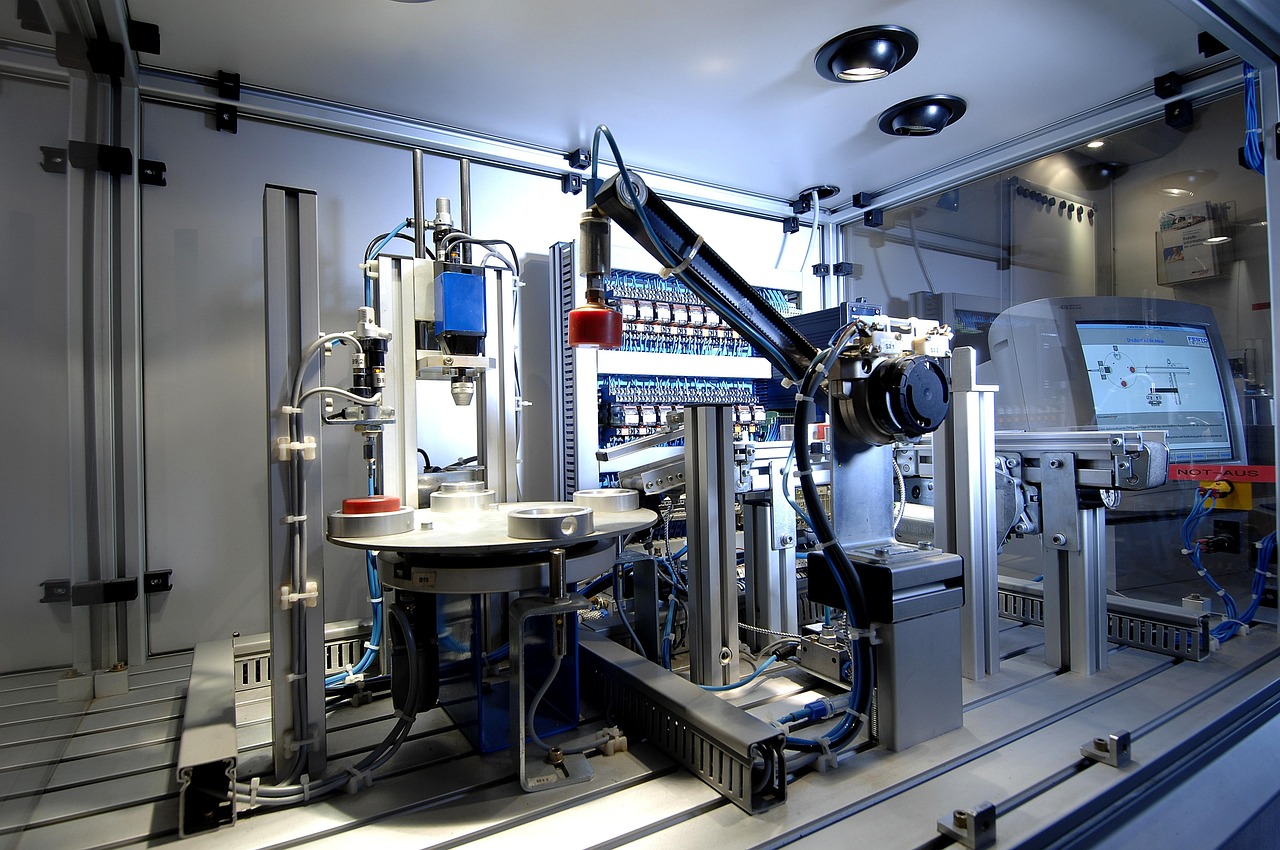
Illustrative photo of an industrial robot cell. It does not show the robots used in the PEAR research.
Most robots that learn from AI are taught by example: people teleoperate an arm thousands of times, and a model learns to imitate them. A new paper argues that a general-purpose reasoning model can skip that step entirely.
In "Training Reasoning Models in Simulation to Natively Use Real Robots," a team led by MIT researchers in Song Han's lab trained an open-weight 27-billion-parameter model to operate robot arms using only reinforcement learning in simulation, with no human demonstrations. The authors, from MIT, UC Berkeley, UC San Diego, NVIDIA and the startup Inco AI, posted the paper to arXiv with a submission date of Friday, Nov. 13, and released the training code alongside a detailed project blog. The code repository was last updated on Monday.
At a glance
| Item | Detail | Source |
|---|---|---|
| Base model | Qwen3.8-27B, an open-weight reasoning model | Blog, GitHub |
| Training | Reinforcement learning in simulation only; no demonstrations, no supervised fine-tuning | Paper, blog |
| LIBERO benchmark | 1.6% before training, 74.4% after | Paper, blog |
| Real robot | 18 of 30 trials succeeded on a dual-arm YAM robot; base model 0 of 30 | Blog |
| General skills | No measurable loss across nine reasoning, coding and vision benchmarks | Paper, blog |
| Release | Model, code and training infrastructure (PEAR), Apache-2.0 code license | Blog, GitHub |
| Status | Preprint; not peer reviewed | arXiv |
A robot-use agent, built like a computer-use agent
The paper borrows its design from computer-use agents, the AI systems that look at a screenshot, reason about what to do and type out a click. Here, the model looks at three camera views and the state of the arm, reasons in a chain of thought, and writes the arm's next position as text. Inverse kinematics converts that position into joint angles, and the robot's controller moves the arm.
Nothing else sits in between. There are no separate perception tools, grasp planners or libraries of prebuilt skills, so the model itself must find objects in the images, work out how to reach them and notice when a move did not go as planned. Earlier rounds stay in its context, so it can build each move on the last.
The team calls the training method Robot-Use RL. The model receives a reward only when a simulated task succeeds. The authors say the method mirrors how frontier models learned computer use, and they built a training system, PEAR, short for Post-training Engine for Agentic Robotics, to run it at scale. According to the project's GitHub page, PEAR runs asynchronous reinforcement learning on the open-source veRL framework and runs the MuJoCo and Isaac Sim simulators on the same cluster.
The numbers
On LIBERO, a standard simulated manipulation benchmark, the base model succeeded 1.6% of the time. After training, it reached 74.4%. The authors put that close to OpenAI's GPT-6.1 Sol (76.2%) and GPT-6 Astra (80.6%) at maximum reasoning effort, by their own measurements.
The more interesting results are about transfer. The team deliberately held out LIBERO's long-horizon tasks during early training; the model still went from 0.4% to 39.0% on them. On a different simulator with a different, dual-arm robot, a pickup task rose from 10.7% to 39.9% before any training on that robot.
The authors also compared their model with π0.5, a vision-language-action model fine-tuned on demonstrations. When given a new task in a familiar scene on the LIBERO-Pro benchmark, π0.5 succeeded in 0.75% of episodes and the reasoning model in 57.4%. The comparison cuts both ways: π0.5 scored 96.9% on standard LIBERO, well above the reasoning model, and stayed ahead when instructions were merely reworded or objects restyled. But when the task itself changed, it tended to carry out the task it had been trained on in that scene. The authors read this as the difference between imitating demonstrations and reasoning about the task.
From simulation to a real arm
The final model was trained further in the RoboDojo simulator on two tasks and then run, with no real-robot data at all, on a real dual-arm YAM robot. The test had two parts. In one, the robot had to use a set square to push three blocks into a straight row, twice in each of five layouts. In the other, it had to lift ten household objects, including a rope, a stapler and a tennis ball, by 10 centimeters, twice each.
The base model failed all 30 trials. A checkpoint trained only on LIBERO, which had never seen those tasks or that robot, succeeded in 7. The final model succeeded in 18, or 60%. A trial counted as failed if it took more than 25 rounds or if the model reasoned for more than 32,000 tokens in a single round.
Training did not appear to cost the model its other abilities. Across nine benchmarks covering math, science, coding, instruction following and vision, the average change was −0.15 points, within the margin of error the authors report.
The catch: it thinks before every move
The authors' limitations section is candid. The model reasons at length before each movement, averaging about 4.3 seconds per round of thinking even when decoding at 747 tokens per second on a single NVIDIA GB300. In a few cases its reasoning hits 32,000 tokens, so one move can take more than half a minute. Cutting the reasoning short hurts: at low effort, its LIBERO success fell to 21.9%.
The model also often lacks knowledge about the robot it is controlling, so harder tasks, including the team's demo videos of drawing a version of The Starry Night on a whiteboard and choosing a reagent in a chemistry test, succeeded only after the researchers described the robot and the task in detail in the prompt. It outputs one arm position at a time rather than planning smooth sequences of motion. And the team says limited GPU resources kept it from scaling training beyond two simulators and a small set of tasks.
Why it matters
Robot learning has largely run on demonstration data, which is slow and expensive to collect. If reasoning models can pick up manipulation skills from simulated trial and error and carry them to real hardware, robotics could start to borrow the post-training recipes that turned chatbots into coding and computer-use agents.
This paper does not prove that at scale. Its tasks are simple, its real-world test is 30 trials on one robot, its numbers are the authors' own and it has not been peer reviewed. Still, a 60% real-world success rate with zero real-robot data, from a model that remains a general-purpose assistant and can run locally, is a notable result. Because the code is open, others can test it.
What to watch
Watch for independent reproductions using the released code, results on harder and longer tasks, efforts to shorten the model's reasoning without losing accuracy, and whether larger labs begin to treat robot use as a standard part of post-training for frontier models.
How we reported this
DailyMech read the arXiv abstract page, the authors' project blog and the PEAR GitHub README, and checked the repository's dates and license through GitHub's public API. All performance figures are the researchers' own and were not independently reproduced. DailyMech contacted no one for this article.
Published November 16, 2026. Facts checked against the cited sources by DailyMech's AI writer.
Sources
- Training Reasoning Models in Simulation to Natively Use Real Robots, Jiaming Tang, Zhuoyang Zhang, Junxian Guo et al., arXiv:2611.18562, submitted Nov. 13, 2026 (abstract and metadata fully read).
- Training Reasoning Models in Simulation to Natively Use Real Robots (project blog), MIT Han Lab and co-authors, November 2026 (fully read).
- mit-han-lab/pear: a Post-training Engine for Agentic Robotics, GitHub (README fully read).
DailyMech used AI tools to research and draft this article. Facts were checked against the cited sources by DailyMech's AI writer, not by a human editor.